

TNPSC Group 1 · Module 1 · Mains depth · 28 min
Stone Age and Chalcolithic cultures
What TNPSC Group 1 asks from this chapter
Syllabus lines this chapter covers:
- Part A: General Studies · History and culture of India, and the Indian national movement.
TNPSC Group 1 questions from this module are being sorted into our bank.
Read at full depth: basics, the standard layer and the Mains analysis.
Start from zero: how people went from hunting to villages
For most of human history, nobody farmed. People moved with the seasons, gathering plants and hunting animals, and made their tools from stone. Historians call this long age the Stone Age, because stone tools are what survive.
There was no writing then, so everything we know comes from archaeology: tools, bones, seeds, pots, hearths and paintings dug out of the ground. Because the deepest layers are usually the oldest, archaeologists read a site like a stack of pages. That method is called stratigraphy.
The story has three big turns. First, humans learned to make better and smaller stone tools. Second, after the last Ice Age, some groups began to grow crops and keep animals, and settled in villages.
Third, farmers began to use a little copper alongside stone, and some villages grew into chiefdoms. These Chalcolithic cultures existed before, alongside and after the Harappan cities. Knowing them helps you see that India's past was never one single story.
The ages at a glance
| Age | Rough time | Tools and life | Key sites |
|---|---|---|---|
| Lower Palaeolithic | From about 1.9 million years ago | Handaxes, choppers; hunting-gathering | Rawalpindi area, Adamgarh, Bhimbetka |
| Middle Palaeolithic | About 80,000-40,000 years ago | Flakes, scrapers of chert and jasper | Bhimbetka, Budha Pushkar |
| Upper Palaeolithic | 40,000-10,000 years ago | Blades, burins, bone tools; early art | Bhimbetka, Patne |
| Mesolithic | After about 10,000 years ago | Microliths; huts; some herding | Chopani Mando, Bagor |
| Neolithic | From about 7000 BC (Mehrgarh) | Polished axes; farming, herding, villages | Mehrgarh, Burzahom, Koldihwa, Chirand, Utnur |
| Chalcolithic | About 3rd to 1st millennium BC | Stone plus some copper; painted pottery; chiefdoms | Ahar, Balathal, Kayatha, Daimabad, Inamgaon |
| Iron Age | Iron from about 2000 BC; widespread by about 1000 BC | Iron tools alongside older crafts | Dadupur, Malhar, Atranjikhera |
These stages overlap. In the Holocene, hunter-gatherers, farmers and copper-using villagers often lived at the same time in different regions.
The Old Stone Age: tools, camps and the first art
How old? The earliest evidence of humans in the subcontinent comes from near Rawalpindi in Pakistan, about 1.9 million years ago. Most human evolution took place in the geological age called the Pleistocene, which lasted from about 2 million years ago to about 10,000 years ago. Throughout this vast span, people lived as hunter-gatherers.
Three phases by tools. Archaeologists divide the Palaeolithic by tool types and layers. The Lower phase has chopper-chopping tools and handaxes (bifaces, flaked on both sides), mostly of quartzite. The Middle phase, from about 80,000 years ago, has flake tools, especially scrapers, made of finer stones like jasper and chert.
The Upper Palaeolithic. From about 40,000 years ago come blades and burins, struck carefully from prepared stone cores. This was a kind of mass production, giving sharper and more varied tools, and bone tools also appear. At Adamgarh Hill (Hoshangabad) and Bhimbetka in Madhya Pradesh, tools become steadily smaller from layer to layer.
Where did they live? Early humans chose places with stone for tools and water nearby. Sites cluster in the Himalayan foothills, along the edges of the Ganga plain next to the central Indian hills, around the Thar Desert and across central and peninsular India. Dense forests such as those of Kerala and the north-east were generally avoided.
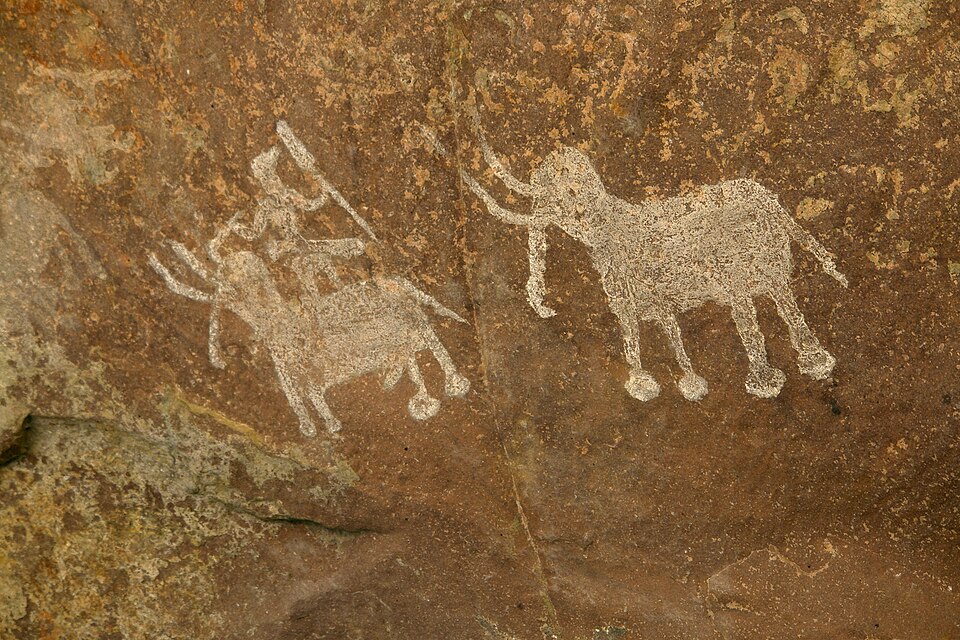
What were camps like? Rock shelters give the best evidence, since river banks may hold tools carried there by floods. At Budha Pushkar, around a lake in the Thar Desert, clusters of tools suggest small camps used again and again. Such sites are habitation sites, factory sites near raw material, or both.
Bands, not tribes. To understand how such people lived, historians turn to studies of living hunter-gatherers. Elman Service and Marshall Sahlins describe bands of about 20 to 50 people, with members coming and going. The family was the main unit, and men from several families joined only for a big hunt.
Gatherer-hunters. Wild plants, gathered mainly by women, may have formed a bigger share of the diet than meat. Food was eaten soon after it was found, so there was little storage or surplus. Bands were egalitarian, with no permanent leader, and quarrels were often settled by one group simply moving away.
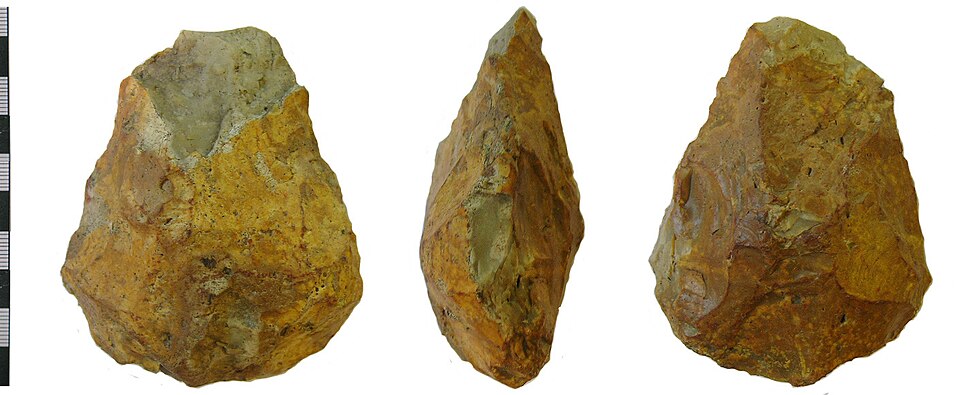
The first art. Rock paintings, engravings and bruisings survive in central India's sandstone shelters, in Ladakh and in south India. Decorated ostrich eggshells from Rajasthan are dated to about 40,000 years ago, and those from Patne to about 25,000 years ago. Many early paintings show hunting, perhaps as magic to ensure success.
Dating the art. At Bhimbetka, paintings in green pigment were linked to Upper Palaeolithic layers where green pigment pieces were found. V.S. Wakankar took green as the colour of the oldest paintings, but early paintings in red are also known. Some scholars see such art from about 35,000 years ago as a sign that people already had language.
After the Ice Age: the Mesolithic and the road to farming
A warmer world. Around 10,000 years ago the Pleistocene gave way to the Holocene. The climate grew warmer and wetter, much like today's, and forests and grasslands spread into dry areas. People now depended more on lakes and rivers.
The Mesolithic. Human adaptation to this new world is called the Mesolithic (Middle Stone Age), marked by tiny stone tools called microliths. It sits between hunting-gathering and food production, and people tried a wider range of ways to get food. Some stayed mobile, while others lived around a home base.
Dated sites. Few Mesolithic sites have firm dates, and those of Chopani Mando in the Belan valley are debated, though it has very early hand-made pottery. Bagor on the Kothari river in Rajasthan is the largest Mesolithic site in India, and its first phase begins about 5000 BC. In India the Mesolithic is not a neat bridge; some Mesolithic sites were contemporary with Neolithic and even Chalcolithic cultures.
Advanced Mesolithic villages. Some late sites were permanent or semi-permanent clusters of small huts with earthen floors, hearths and wattle-and-daub walls (reeds plastered with mud). They used grinding stones, querns and microliths, and their animal bones include both wild and domesticated species. The querns may have processed wild plants that were gathered or even grown.
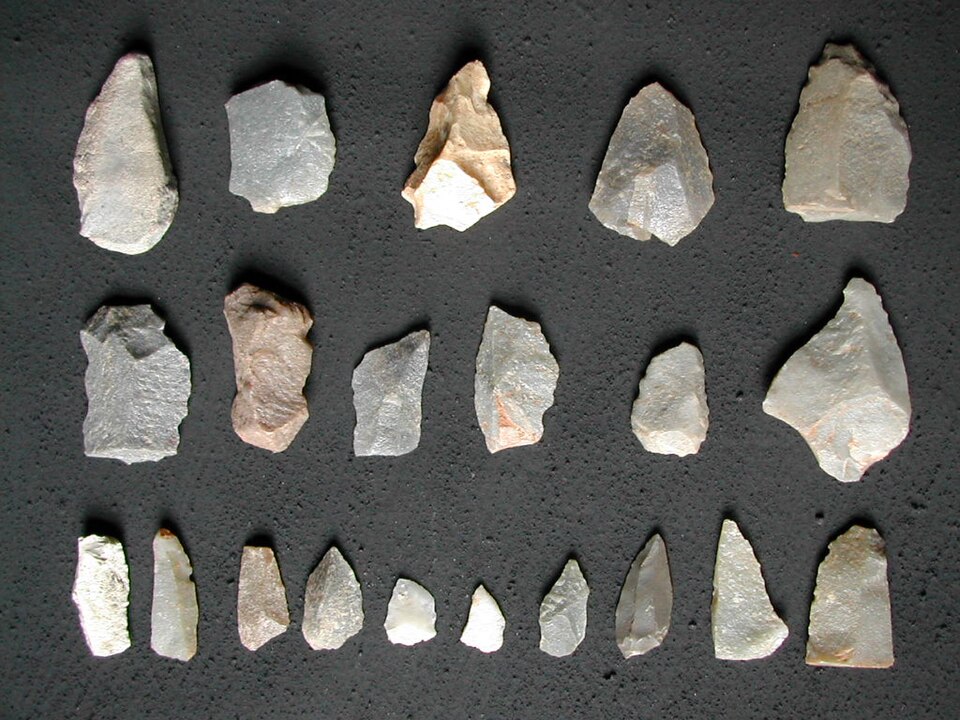
A change in the hunt. Microliths are tiny, usually 1 to 8 cm long, and include blades, points, triangles, lunates and trapezes, many fixed in handles as arrowheads. As the climate warmed, people shifted from hunting big game to small game, fishing and fowling. Rock paintings at Bhimbetka and Adamgarh now show hunting and fishing, and even childbirth, child-rearing and burial, which suggests a more settled social life.
How domestication works. Domestication is a slow process in which humans create new forms of plants and animals. Early farmers kept seeds from plants that held their grain until harvest and grew in bunches, so they were easier to reap. Over generations this choice produced crops that depended on humans.
Which animals? Animals that are placid, social and follow a leader are easiest to tame. That is why goat and sheep were the first to be domesticated in the Near East. Herding began with following wild herds, then drawing them close, then penning them.
Why was it a revolution? V. Gordon Childe called this shift the 'Neolithic Revolution'. It took about 2,000 years in the Near East, so the change was slow, but its impact was huge. Humans now controlled their food supply, could move crops to new areas, stored grain, made pottery for storage and cooking, and lived in villages.
Why did people choose it? One popular explanation links farming to the environmental changes after the last Ice Age, which pushed some groups towards wild grasses and pulses. Farming was not always better; for some millennia it was not clearly superior to foraging. Groups with rich wild resources often did not farm even when they knew how.
What changed in society? Farming needs months of joint work from sowing to harvest and stored food to last till the next crop. So farmers formed larger and more lasting kinship groups. Children could help in the fields, families no longer had to limit their size, and population grew.
The first farmers of the subcontinent
Mehrgarh, the first village. The earliest farming settlement in the subcontinent is Mehrgarh in Baluchistan (Pakistan). It lies in the fertile Kachi plain on the Bolan river, at the foot of the Bolan Pass, an old route between the hills and the Indus plains. It began as a camp around 7000 BC.
What Mehrgarh grew and kept. Its first period was aceramic, meaning without pottery, and pottery appears in the second. People lived in small mud-brick houses, grew wheat and barley, and slowly shifted from hunting gazelle and other wild animals to keeping goats, sheep and cattle. Sickles were made by setting stone blades in bitumen on a handle.
Contacts from the start. Even the earliest people of Mehrgarh used lapis lazuli, turquoise and marine shell. Shell came from the Makran coast, lapis from Badakshan or Chagai, and turquoise from beyond the Oxus. So the first farmers were already linked to exchange networks from the Arabian Sea to Central Asia.
Mehrgarh grows. By about 5500 BC it had store-rooms, terraces and its first coarse pottery. By about 4000 BC it covered some 50 hectares, used copper on a significant scale, made pottery on the potter's wheel and produced many female terracotta figurines. Farming villages spread across Baluchistan and, in the second half of the 4th millennium BC, into the Indus plains.
Cotton and the Harappan inheritance. In a later, copper-using phase around 5000 BC, Mehrgarh also grew cotton alongside wheat and barley. The Harappans probably inherited wheat, barley and cotton farming from such early ancestors. This is why Mehrgarh matters so much: it links the first villages to the first cities.
Why did farming come here first? Wheat, barley, sheep and goat suit the wet winters of western Asia better than the summer monsoon. Because domesticated crops appear suddenly at Mehrgarh, many scholars think the knowledge of farming spread from Iran, through migration, trade and marriage. Others point to the local domestication of sheep, goat and cattle there and see the Kachi plain as an independent centre, so the question is still open.
Kashmir: living in pits. At Burzahom and Gufkral in Kashmir, Neolithic farmers of the third millennium BC lived in pit dwellings, which are warmer than the surface in long cold winters. They used ground stone axes and bone tools, grew wheat, barley and lentil, and still hunted ibex, deer and bear. In the later phase they built mud houses and buried dogs alongside humans.
Contact with the Indus. At Burzahom a wheel-made pot held 950 beads of agate and carnelian, probably from the Indus plains. Another pot carried a 'horned deity' motif of Indus inspiration. Even remote farmers were part of wider networks.
Rice in the east. Koldihwa in the Vindhyan hills, with rice husks in its pottery, is seen as the earliest rice-growing culture of the subcontinent. Only three of its nine radiocarbon dates go back to the 7th-6th millennia BC, so its age is debated. Lahuradeva in the Ganga plain has cultivated rice from the late 6th-early 5th millennium BC.
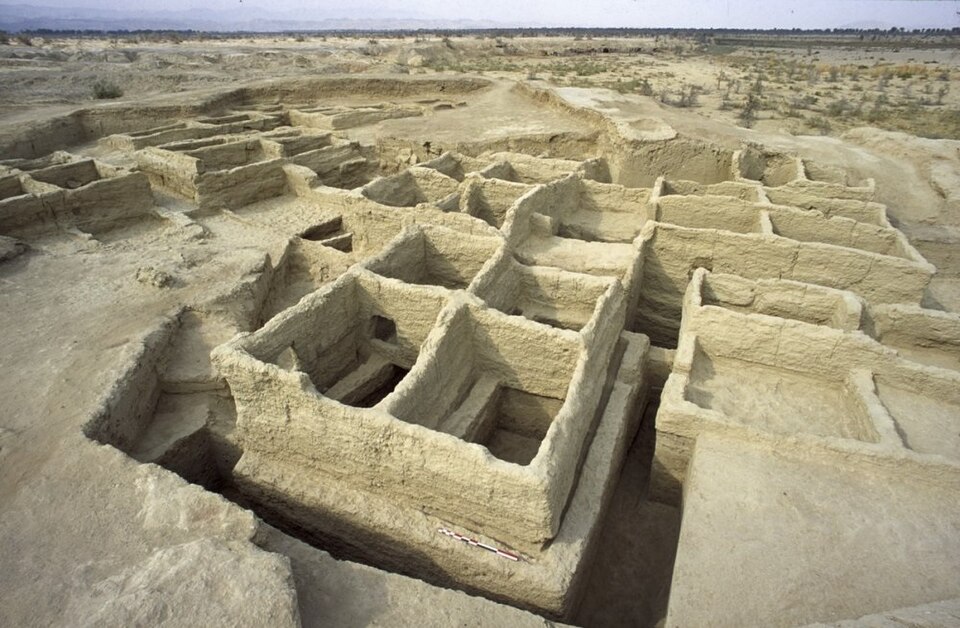
Bihar's farming villages. In north Bihar, Chirand, Chechar-Kutubpur, Senuar, Maner and Taradih were river-bank villages. Chirand's Neolithic layer is 3.5 m thick, with bone and antler tools, rich microliths, and crops like rice, wheat, barley, moong and lentil. These were pre-metal villages, though their exact dates are debated.
The north-east. In the hills of Assam, sites such as Deojali Hading in the North Cachar hills have shouldered celts, small ground axes and cord-impressed pottery. Similar tools are common in China and South-East Asia, though the link is not settled. This Neolithic phase is tentatively dated around 2000 BC.
The south: ash mounds. The southern Neolithic of the Deccan is famous for ash mounds, created by burning heaps of cattle dung at ancient cattle pens. Sites like Utnur, Kodekal, Kupgal and Palavoy belong to the third millennium BC, and more than 60 ash mounds are known. Herding was central, but people also grew ragi and local pulses such as horsegram and mungbean, which may have been domesticated there.
Many beginnings. Taken together, the evidence from Ladakh to the Vindhyas and the Deccan shows that food production in India was not a single event. Wheat-barley farming in the north-west, rice in the Ganga-Vindhya belt and millets and pulses in the south grew from different roots. The food habits of these regions still echo those early choices.
Copper and stone: the Chalcolithic cultures
What 'Chalcolithic' means. The word means copper-stone. Chalcolithic people were farming communities who still used mainly stone tools, with some copper objects that often copied stone shapes. The Bronze Age is different: it means regular use of copper-bronze tools, long-distance trade for rare tin, and usually cities and states.
Why copper mattered. Copper is far rarer than stone, and tin rarer still. So metal created demand for trade and for people who could organise it. Not surprisingly, the first sedentary communities of Rajasthan grew up in copper-rich zones.
Ganeshwar-Jodhpura. In north-east Rajasthan, mainly around Sikar, the Ganeshwar-Jodhpura culture lay in the Khetri copper belt. A small 3-4 acre settlement at Ganeshwar yielded several hundred copper arrowheads, spearheads, bangles and chisels. That is far more than its people needed, so it probably supplied copper to early Harappan and Harappan settlements.
The Ahar culture. In south-east Rajasthan (Udaipur, Chittorgarh and Bhilwara), the Ahar or Banas culture used a distinctive white-painted black-and-red ware, and Ahar itself shows copper smelting. Its beginnings at Balathal go back to about 2800 BC, so it began before the Harappan cities. There are more than 50 Ahar sites, mostly small.
Fortified centres. By the early 2nd millennium BC, Balathal had a fortification 4.8-5 m wide, mud-brick houses and a street. Gilund had two fortified mounds, one high and one low, recalling Harappan towns. These may have been regional centres of chiefdoms.
Malwa. In the Chambal valley, the Kayatha culture (Ujjain district) dates to around the end of the 3rd millennium BC. It used copper axes and a microlithic blade industry, and yielded 40,000 steatite microbeads like Harappan ones. It was followed by an Ahar-like phase and then the Malwa culture, which also spread into Maharashtra.
Maharashtra: Savalda and Jorwe. The Savalda culture of the Tapi basin, best known from Daimabad, was contemporary with the Harappans. At Daimabad one house with a shell-decorated floor is called a 'nobleman's' house, and another with an agate linga a 'priest's' house, hinting at inequality. Later came the Jorwe culture (about 1400-1000 BC, with Late Jorwe to about 700 BC).
Inamgaon: a chief's village? Inamgaon, on the Ghod river in the Bhima valley, was dug by the Deccan College from 1968 to 1983, one of the longest Chalcolithic excavations in India. Its phases run from the Malwa (1600-1400 BC) through Early Jorwe (1400-1000 BC) to Late Jorwe (1000-700 BC). M.K. Dhavalikar read it as the seat of a chiefdom.
The evidence for a chief. In the Early Jorwe phase a five-room house stood in the centre, next to a granary with pit silos, while other houses had one room. In its courtyard, a man was buried sitting in a four-legged clay jar with his feet intact, while the usual practice was to cut off the feet of the dead. A two-year-old girl was buried with a necklace of jasper and copper beads, suggesting inherited status.
Public works. Inamgaon also had a fortification wall and ditch, a long irrigation channel, and a massive embankment to divert floods. Such works needed labour mobilised by someone with authority. Dhavalikar thought the chiefship passed to another family in the Late Jorwe phase.
Other centres. Each Jorwe region had one big centre: Prakash in the Tapi basin, Daimabad in the Godavari valley and Inamgaon in the Bhima valley. In Madhya Pradesh, Nagda and Eran were more complex than ordinary villages; Eran had a massive rampart and ditch. Size hierarchies like these are a sign of chiefdoms.
The doab and copper hoards. In the Ganga-Yamuna doab, the first farmers belonged to the chalcolithic Ochre Coloured Pottery (OCP) culture. It is linked with 'copper hoards' of harpoons, swords and axes, and coexisted with the Harappans in parts of the doab. After the Harappan decline, late Harappan groups merged with OCP and local cultures.
Not isolated villages. These cultures traded copper, stones and other goods with the Harappans. Etched carnelian beads at Ahar and steatite microbeads at Kayatha and in Bihar show the links. The Harappans may also have adopted rice from cultures to their east.
Farming, faith and a famous hoard. Chalcolithic farmers on the black cotton soil grew barley as their main cereal, along with wheat, rice, millets and pulses, and Inamgaon shows crop rotation. Many terracotta bulls suggest the bull was sacred, and female figurines point to worship of a mother goddess. At Daimabad, a chance find of four solid copper objects, an elephant, a rhinoceros, a buffalo and a chariot with a rider, weighs over 60 kg.
Decline into poverty. In the Late Jorwe phase, large rectangular houses gave way to small round huts in clusters. Growing aridity at the close of the 2nd millennium BC hurt farming, and many people turned to sheep and goat herding and a semi-nomadic life. This shows how closely these early societies depended on rainfall.
Iron: early arrival, slow impact
Earlier than expected. Iron reached India earlier than once believed. Iron objects come from Harappan sites such as Lothal and Allahdino, from the Ahar culture (12 objects in phases dated from about 2100 BC) and from an iron-bearing level at Gufkral in Kashmir. So the technology of iron begins at the end of the 3rd and start of the 2nd millennium BC.
The Ganga plain. In Uttar Pradesh, Dadupur near Lucknow has iron from about 1700 BC, and Jakhera (Etah) has iron in a black-and-red ware level. Malhar and Raja Nal ka Tila show smelting from the 2nd millennium BC, and Jhusi near Allahabad from about 1100 BC. By about 1000 BC, large parts of the subcontinent were in the Iron Age.
Technology versus age. Historians separate the first appearance of iron from the Iron Age, when iron becomes common in a region's sequence. Iron in a few early contexts did not change much at first. In eastern India, black-and-red ware cultures used iron by the end of the 2nd millennium BC, yet cities came centuries later.
Not a revolution. Some scholars made iron the key to clearing the Ganga forests and creating the surplus for cities around 600 BC. But iron appears in the Ganga plain about a thousand years before its first cities, and crops and pottery at sites like Malhar continue from the copper phase into the iron phase. So iron sustained the second urbanisation but did not cause it alone.
What did cause cities? Growing population, a secure farming base, trade networks and the rise of states all combined. At Atranjikhera, in the Painted Grey Ware phase, people used beads of agate and carnelian, copper objects, 135 iron objects and chir pine, none of which was local. A class of traders was already moving raw materials into the Ganga plain.
Mains lens: bands, tribes and chiefdoms
From band to tribe. Historians use stages of social organisation to read prehistory. Bands of hunter-gatherers were small, mobile and egalitarian, with the family as the stable unit. Tribes of farmers were larger groups of 100 or more, bound by kinship, common ancestors and joint ownership of resources.
How tribes held together. In a tribe, the extended family pooled labour and shared risk. Marriage alliances, gift exchange, age-sets and even endless small wars between tribes kept people united. Leaders were 'big men' whose influence rested on personal qualities, not on real power.
The chiefdom. A chiefdom adds ranked status groups, often a hereditary chief and a redistributive economy. The chief receives tribute as 'first fruits' and gives much of it back as gifts, feasts and support in hard times. Archaeologists look for bigger houses, storage next to them, wealth in graves, especially of children, and a hierarchy of settlement sizes.
Why Inamgaon matters. Inamgaon shows all these signs, so it is the classic Indian example of a Chalcolithic chiefdom. But chiefdoms are unstable; they tend to split rather than grow into states. A state needs institutions that override kinship, such as rulers who control resources by force.
Was farming a 'revolution'? Childe's phrase stresses impact, and farming did transform society. Yet the change took millennia, farming was not always better than foraging, and different regions adopted it at different times and with different crops. A good answer weighs both sides.
One story or many? Indian prehistory shows multiple lines of development. Wheat-barley farming in the north-west, rice in the east, millets in the south, and copper-rich chiefdoms in Rajasthan and the Deccan all followed their own paths. No single culture can claim to have built India's farming base.
Mains practice: prehistory and the Chalcolithic
| Angle | Question | Key points to cover |
|---|---|---|
| Transition | "The Neolithic Revolution was a revolution in impact, not in pace." Discuss with Indian examples. | Childe; Holocene change; Mehrgarh 7000 BC; aceramic to pottery; Burzahom pits; Koldihwa rice; ash mounds; storage, villages, population; slow spread; farming not always superior. |
| Society | How does archaeology help us identify a chiefdom? Illustrate with Chalcolithic sites. | Band, tribe, chiefdom, state; Inamgaon house, granary, burials, channel; Daimabad houses; Balathal and Gilund forts; Prakash, Eran; settlement hierarchy; instability of chiefdoms. |
| Technology | "Iron did not cause the second urbanisation." Examine. | Early iron at Lothal, Ahar, Gufkral, Dadupur; Iron Age by 1000 BC; thousand-year gap; continuity at Malhar; Atranjikhera trade; population, farming, states. |
These are practice questions written by us, not past papers. Past questions from your exam appear in the PYQ panel.
How to use this table: each answer should explain the what, then the why, and end with what it led to.
Quick revision
- Earliest humans: near Rawalpindi, about 1.9 million years ago. Pleistocene to about 10,000 years ago, then Holocene.
- Lower Palaeolithic: handaxes, choppers, quartzite. Middle (80,000-40,000): flakes, scrapers, chert/jasper. Upper (40,000-10,000): blades, burins, bone tools.
- Art: ostrich eggshells (Rajasthan about 40,000; Patne about 25,000); Bhimbetka green pigment (Wakankar).
- Bands of 20-50; egalitarian; 'gatherer-hunters'.
- Mesolithic: microliths; Chopani Mando (early pottery); Bagor (largest Mesolithic site; from about 5000 BC).
- Childe: 'Neolithic Revolution'.
- Mehrgarh (Bolan, Baluchistan): from about 7000 BC; aceramic Period I; wheat, barley; goat, sheep, cattle; 50 ha and copper by about 4000 BC.
- Burzahom, Gufkral: pit dwellings; dog burials; 950 beads pot.
- Koldihwa: earliest rice (dates debated); Lahuradeva: rice in Ganga plain; Chirand: Bihar Neolithic.
- Ash mounds: Utnur, Kodekal, Kupgal, Palavoy (3rd millennium BC); ragi, horsegram, mungbean.
- Chalcolithic = stone + some copper. Ganeshwar (Khetri copper); Ahar/Balathal/Gilund (copper smelting; Balathal about 2800 BC).
- Kayatha (40,000 microbeads); Savalda/Daimabad; Jorwe (1400-1000 BC; late to 700 BC).
- Inamgaon (Ghod river; 1968-83; Dhavalikar): five-room house, granary, burial with feet intact, channel.
- Daimabad hoard: elephant, rhinoceros, buffalo, chariot with rider; solid copper, over 60 kg. Late Jorwe decline from aridity.
- OCP and copper hoards in the doab. Iron: Dadupur about 1700 BC; Iron Age by about 1000 BC.