

TNPSC Group 4 · Module 15 · basic depth · 13 min
Miniature painting I: Pala, western Indian, Sultanate and Mughal
What TNPSC Group 4 asks from this chapter
Syllabus lines this chapter covers:
- Part B: General Studies · History and culture of India.
TNPSC Group 4 questions from this module are being sorted into our bank.
Cut to basic depth for TNPSC Group 4. 11 deeper paragraphs are in the full chapter.
Start from zero: what is a miniature?
In the rock art and murals chapter, painting covered walls and ceilings. From about the 10th century, a new kind of painting became important: small, finely detailed pictures made for manuscripts (handwritten books) and later for albums. These are called miniatures.
Why small? A manuscript could be carried, gifted and kept in a library, unlike a cave wall. The small size forced the painter to work with tiny brushes and great precision. A miniature is meant to be held in the hand and looked at closely, page by page.
From palm leaf to paper. The earliest miniatures in India were painted on palm leaves. Later, paper came into use and allowed larger pages and richer colours. This change of material shaped how painting developed in the Sultanate and Mughal periods.
What this chapter covers. We follow the miniature from Pala Buddhist manuscripts in the east and Jain manuscripts in the west, through the painting of the Delhi Sultanate, to the great Mughal school. The next chapter, the Rajasthani, Pahari and Deccani painting chapter, continues the story at the regional courts.
Pala painting: Buddhist manuscripts of the east
Where and when. Under the Pala kings of Bihar and Bengal, Buddhist monasteries became great centres of learning. Monks copied sacred texts on palm leaves and decorated them with small paintings. These are the earliest surviving Indian miniatures.
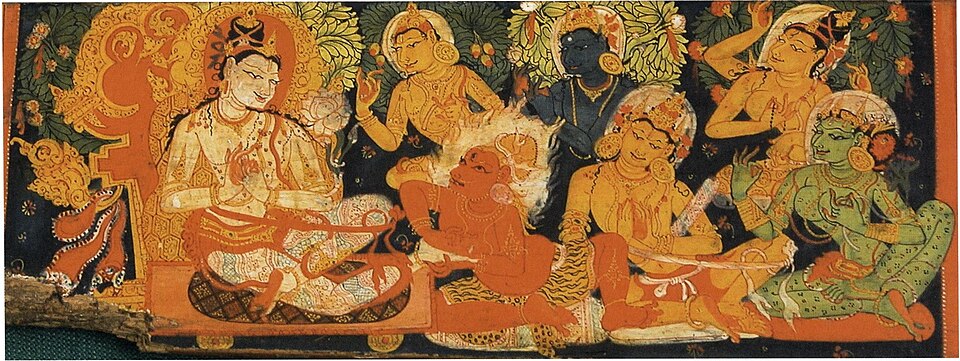
The earliest example. The earliest known example is a manuscript of the Ashtasahasrika Prajnaparamita ("Perfection of Wisdom in 8,000 lines"), of the 10th century, made under Mahipala. It belongs to the Mahayana tradition. Small panels on the leaves show the Buddha, Bodhisattvas and goddesses such as Tara.
Why people paid for them. Lay devotees, monks and princes commissioned such manuscripts as offerings to gain spiritual merit. A copied and painted text was itself a sacred object. This is why so much care went into each leaf.
How they were made. Palm leaves were soaked for about a month, dried, smoothed with conch shells and cut to size. The painter first laid the background colour, then the figures, then shading and black or red outlines. Colours included yellow, chalk white, indigo, lamp black and red.
Style. Pala figures are graceful and rounded, carrying forward the classical style of Ajanta in miniature form. Medieval traits such as sharp, angular limbs and long eyes also appear in Pala manuscripts, as in murals of the same period. Pala art spread its influence to Nepal and Tibet.
Western Indian painting: Jain manuscripts
Where and when. In Gujarat and Rajasthan, a strong tradition of manuscript painting flourished from the 10th to the 14th century, mostly for Jain patrons. Rich Jain merchants paid for copies of sacred texts to be given to temple libraries (bhandaras). Early works are on palm leaf; later ones are on paper.
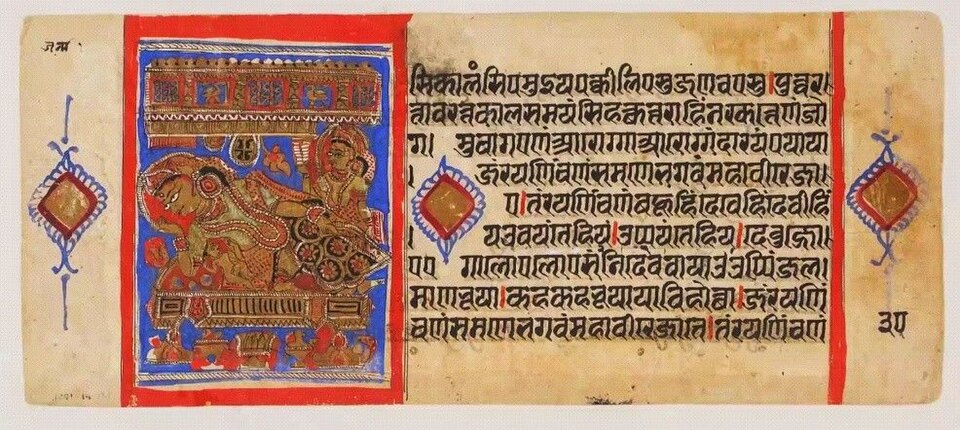
The Kalpasutra. The favourite text was the Kalpasutra of the Svetambara Jains, traditionally linked with Bhadrabahu. It tells the lives of the Tirthankaras, especially Mahavira, and was copied again and again. Panels show scenes such as the birth of a Tirthankara.
A very recognisable style. Western Indian painting is easy to spot. Figures are angular, with sharp noses, and the far eye projects beyond the outline of the face. Colours are bright, the background is usually red, and the drawing is clean and pure.
Why the style matters. This style shows the medieval taste for line and pattern rather than modelling and depth. It shaped early Rajput painting and survived alongside Sultanate painting. When Mughal painting arrived, it met this living regional tradition.
Painting under the Delhi Sultanate
An old myth corrected. It was once believed that painting died out under the Delhi Sultans and was revived only by the Mughals. Newer evidence shows this is wrong. There was a lively tradition of murals and painted cloth in the 13th and 14th centuries.
Evidence from texts. A poem of Iltutmish's time mentions painted walls, and Amir Khusrau describes a painted tent of Qutbuddin Mubarak Khalji. Firoz Shah Tughlaq banned paintings of living figures on palace walls, which itself shows that such paintings existed. The Awadhi poem Chandayan of Maulana Daud (late 14th century) describes painted rooms.
Calligraphy and manuscripts. A tradition of Qur'anic calligraphy lasted to the end of the 14th century; the earliest known Qur'an copied in India was made at Gwalior in 1399. From the early 15th century, illustrated Persian and Awadhi manuscripts appear. Paper, a new material, made this possible.
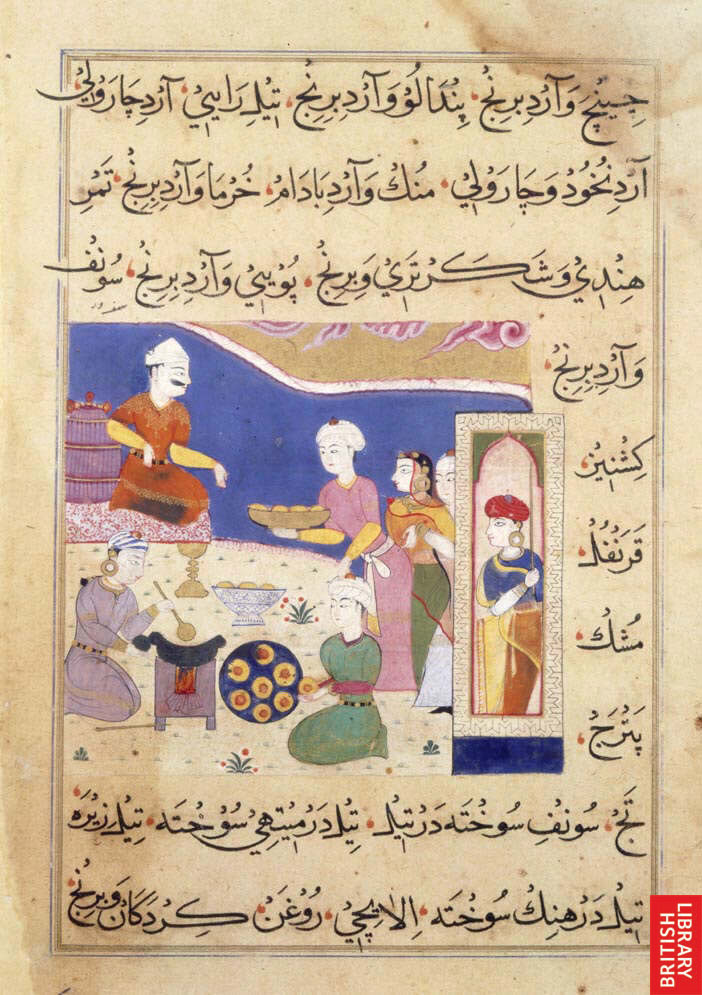
Mandu, the painters' court. At Mandu in Malwa, in the late 15th century, the sultans had manuscripts illustrated. These include the Bostan of Sa'di, illustrated by Hajji Mahmud, and the Ni'mat Nama, a book of cookery. They mix Persian style with Indian elements.
Painting outside the court. Some manuscripts were made for patrons outside the court, such as the Awadhi Laur Chanda (another name for the Chandayan story). Scholars call these "bourgeois" manuscripts because merchants and town elites paid for them. So when the Mughals arrived, a living tradition of manuscript painting already existed.
The beginnings of Mughal painting: Humayun
Babur and Humayun. Babur, who founded Mughal rule in 1526, ruled for only four years and could not do much for painting. His son Humayun was driven out of India by Sher Shah in 1540. In exile, he took refuge at the court of Shah Tahmasp of Persia.
The Persian masters. At the Persian court, Humayun fell in love with painting. He invited two Persian masters, Mir Sayyid Ali and Khwaja Abdus Samad, to illustrate manuscripts for him. They joined him when he returned to India and later shaped Akbar's studio.
A painting on cloth. An important work of Humayun's time is the "Princes of the House of Timur" (c. 1550). It is painted on cloth and is unusually large, about 1.15 metres square. Its large size may come from the Mongol custom of hanging paintings in tents.
Why it matters. Humayun's brief patronage planted features that became typical of the Mughal school. The meeting of Persian masters with Indian painters would soon produce something new. In this sense, Humayun opened the door that Akbar walked through.
Akbar's atelier: the Mughal style is born
The royal studio. Akbar took a deep personal interest in painting and set up a royal workshop called the tasvir khana. Its first major project was the Hamzanama, the adventures of Amir Hamza, begun in 1562. It had about 1,400 unusually large paintings, of which only a small part survives.
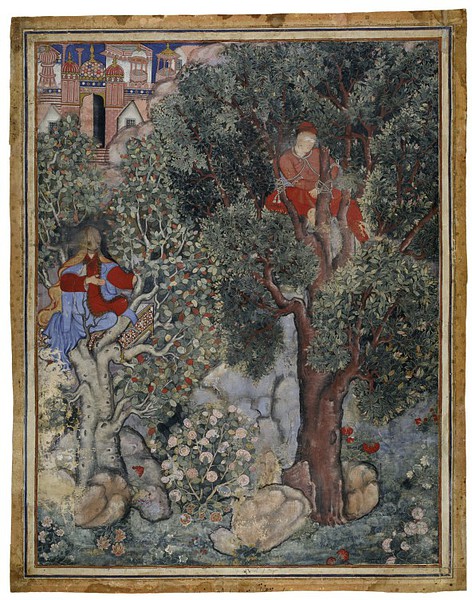
Who the artists were. More than a hundred painters worked in the atelier, and most of them were Hindus. Akbar valued skill above birth: Daswant, the son of a palanquin-bearer, rose to be a royal artist. Other famous names include Basawan, Kesu, Mukund and Lal.
How the studio worked. The artists were salaried employees, helped by gilders, line-drawers and page-makers. Officers called daroghas supervised the work, supplied materials and presented the paintings to the emperor every week for rewards. A single painting was often a team effort: one artist drew the outline, another coloured the faces and a third painted the rest.
What they painted. The atelier illustrated histories such as the Akbarnama, the Baburnama and the Timurnama, Persian classics such as the Anwar-i Suhaili and the Tutinama, and Hindu epics in Persian, such as the Razmnama (Mahabharata, 1582). Painting history as a record of real events was a new emphasis. Battles, sieges, river crossings and court audiences became familiar scenes.
A new style. Early works show clear Persian features: symmetry, fine lines, flat architecture and jewel-like buildings. Within about fifteen years, and clearly by around 1590, a distinct Mughal style emerged. It had Indian dress and objects, vigorous movement, rich foliage and scenes set deep in the background; its action and movement were found neither in Persian nor in earlier Indian art.
Jahangir and Shah Jahan: the peak and the polish
Jahangir the connoisseur. Under Jahangir (1605–27), Mughal painting reached its zenith. He kept his own studio even as a prince and personally guided his artists. He was proud that he could tell which artist had painted which part of a picture.
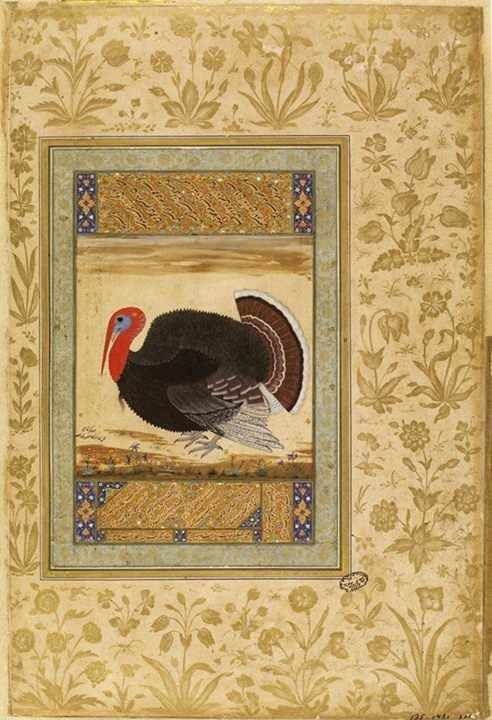
From books to single pictures. Under Jahangir, illustrated manuscripts became less important than single pictures collected in albums (muraqqa). Portraits, court scenes and studies of nature became favourite subjects. Pictures were set in broad margins (hashiya) richly decorated with plants, birds and figures.
The naturalist emperor. Jahangir was a keen observer of nature. Whenever he saw a strange bird or animal, he had it painted at once. Ustad Mansur was famous for birds and animals, and Abul Hasan, Bishandas (portraits), Manohar and Govardhan were other great names.
Shah Jahan. Under Shah Jahan (1628–58), better known for architecture, painting continued but grew more formal. Colours became more decorative, with much more gold. The great illustrated history of his reign, the Padshahnama, shows court scenes with minute detail, along with love scenes and portraits of women.
Aurangzeb and after. Aurangzeb withdrew imperial patronage, and painting moved to the studios of nobles. Under Muhammad Shah (1719–48) interest revived briefly, but many painters had already migrated to provincial courts. As one historian put it, the loss of the Mughals was the gain of the regional styles.
Quick revision
- Miniatures = small paintings for manuscripts and albums; palm leaf first, then paper.
- Pala (Bihar, Bengal): Buddhist palm leaf; earliest Ashtasahasrika Prajnaparamita (10th c, Mahipala); leaves smoothed with conch; offerings for merit.
- Western Indian / Jain (Gujarat, Rajasthan, 10th–14th c): Kalpasutra; angular figures, projecting far eye, red ground.
- Sultanate: murals, painted cloth, Qur'an (Gwalior 1399); Persian and Awadhi manuscripts from 15th c; Mandu: Bostan, Ni'mat Nama; Laur Chanda.
- Humayun: Shah Tahmasp's court; Mir Sayyid Ali, Abdus Samad; Princes of the House of Timur (c. 1550, cloth).
- Akbar: tasvir khana; Hamzanama from 1562; mostly Hindu artists (Daswant, Basawan); salaried teams, daroghas; Akbarnama, Baburnama, Tutinama, Razmnama 1582; distinct style by ~1590.
- Jahangir: zenith; albums, portraits, nature; Mansur (birds, animals), Abul Hasan, Bishandas; decorated hashiya. Shah Jahan: gold, Padshahnama. Aurangzeb: decline; painters to provinces.
- European influence: depth, light and shade, haloes, angels; prints in Jahangir's and Dara Shikoh's albums; no oil.