

UKPSC RO / ARO · Module 8 · standard depth · 18 min
Peasant, tribal and worker protests after 1857
What UKPSC RO / ARO asks from this chapter
Syllabus lines this chapter covers:
- Prelims: General Studies (100) and General Aptitude Test (50) · History of India and Indian National Movement
- Mains Paper 1: General Studies (objective, 200 questions) · History and culture of India and Uttarakhand
UKPSC RO / ARO has asked 1 question from this chapter (2023); 2 from its whole module.
Cut to standard depth for UKPSC RO / ARO. 11 deeper paragraphs are in the full chapter.
Start from zero: why did the villages keep rising after 1857?
Imagine a family that has farmed the same land for generations, gathered wood from the nearby forest and grazed its cattle on the village common. One day a new law says the land belongs to a landlord, the forest belongs to the government and the tax must be paid in cash by a fixed date. To pay it, the family borrows from a moneylender at a crushing rate, and slowly the land slips away.
That is the story behind most of the protests in this chapter. The British crushed the Revolt of 1857, as told in the chapter on the revolt's spread and legacy, but the anger in the villages did not die. After 1857 the government began to treat landlords as the 'natural leaders' of the people, so peasants now faced the colonial state and the landlord together.
New land settlements created a market in land and did away with customary rights to forest and pasture. Cash payment of revenue fed moneylending, and in tribal areas outsiders, as moneylenders and landlords, took control of the economy. Artisans, ruined by British machine goods, crowded onto the land and added to the pressure.
This chapter follows the peasants of Bengal, Malabar and the Deccan, the tribals of Orissa, Andhra and Chotanagpur, and the first industrial workers. Keep one question in mind as you read. Were these protests only local outbursts, or did they prepare the ground for the national movement?
Protests at a glance
This table lists the main protests of this chapter. Each one is explained in the sections that follow.
| When | Where | Who and against whom | Key point |
|---|---|---|---|
| 1854-57 | Ghumsar, Baud, Parlakhemedi (Orissa) | Khonds and Savaras; Chakra Bisoi, Radhakrishna Dandasena | Meriah ban and loss of autonomy. |
| 1859-60 | Lower Bengal | Indigo peasants against planters | Enquiry 1860; Nil Darpan. |
| 1870s-1896 | Malabar | Moplah tenants against jenmi landlords | Class conflict given a communal colour. |
| 1873-85 | Pabna (Bengal) | Tenants against zamindars | Agrarian league; 'Queen's ryots'. |
| 1875 | Deccan (Poona, Ahmednagar) | Kunbi cultivators against Vani moneylenders | Bonds and deeds destroyed. |
| 1879-80 | Eastern Godavari, Malkangiri | Koyas under Tomma Dora | Forest rights; Motu police station seized. |
| 1874-1901 | Chotanagpur | Mundas under Birsa (from c. 1895) | Against dikus, zamindars and Europeans. |
| 1862, 1884, 1890 | Howrah, Bombay | Railway and mill workers | Eight-hour strike; Lokhande's memorandum; weekly holiday. |
Look at the 'against whom' column. Most protests were aimed as much at landlords and moneylenders as at the British, which is why historians call them struggles against both colonialism and its Indian allies.
On the eve of 1857: Orissa, the Santhals and the people's revolt
Many names for one anger. The risings of this period went by local names: fituri, meli, hool and ulgulan. Officials usually recorded them as 'riots', 'dacoities' or 'crimes'. Behind the labels, however, were people protesting against a new order that was taking away their land and rights.
The Khonds and Savaras of Orissa. Between 1854 and 1856 the Khonds of Ghumsar and Baud rose, and their resistance was linked with Chakra Bisoi, who had avoided arrest since 1837. One grievance was the British attempt to stop the meriah human sacrifice, which the Khonds performed to win good turmeric harvests in uncertain times. In 1856-57 the Savaras of Parlakhemedi rose under Radhakrishna Dandasena, who was hanged in 1857, and nothing more was heard of Chakra Bisoi after October 1856.
The Santhal Hul. The great Santhal rising is studied in the chapter on uprisings before 1857. Moneylenders had charged interest of 50 to 500 per cent and cheated with two measures, a big one (bara ban) to take goods and a small one (chota ban) to give them. On 30 June 1855 about ten thousand Santhals gathered to hear Sido and Kanhu announce that their god had ordered them to throw off their oppressors, and the rising turned from moneylenders to the police, planters, railway engineers and officials.
The people's side of 1857. Historians differ on how far ordinary people led the Revolt of 1857. Eric Stokes argued that peasants and artisans followed a rural elite whose interests were threatened, while S.B. Chaudhuri and Rudrangshu Mukherjee stressed the strength of popular participation. Rebels called British rule 'Bania ka Raj', burnt records and account books, and in places dismantled factories, while in Bihar Kunwar Singh stopped his followers from destroying property deeds.
The indigo revolt, 1859-60: when peasants said no
What was the grievance? European planters in Bengal relied on force and on the colonial courts to make peasants grow indigo on their land. Indigo paid little, and growing it meant peasants could not grow the food grains they needed to survive. The contract, once signed, was almost impossible to escape, as the colonial economy chapter explains.
How did they resist? By 1859 thousands of peasants had withdrawn their labour from indigo. They formed organisations across the indigo districts and resisted the repression of the planters and their armed retainers. What made the revolt powerful was its discipline: whole villages refused together.
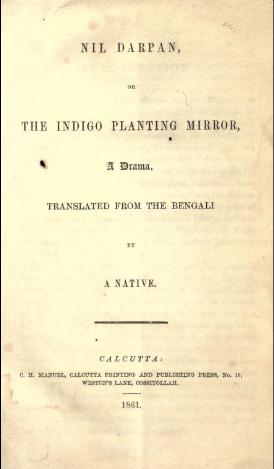
The press and the stage. Newspapers such as the Bengalee reported the struggle and its success. Dinabandhu Mitra's Bengali play Nil Darpan (1860) showed the planters' cruelty to a wide audience. This was one of the first times the educated middle class openly took the side of peasants.
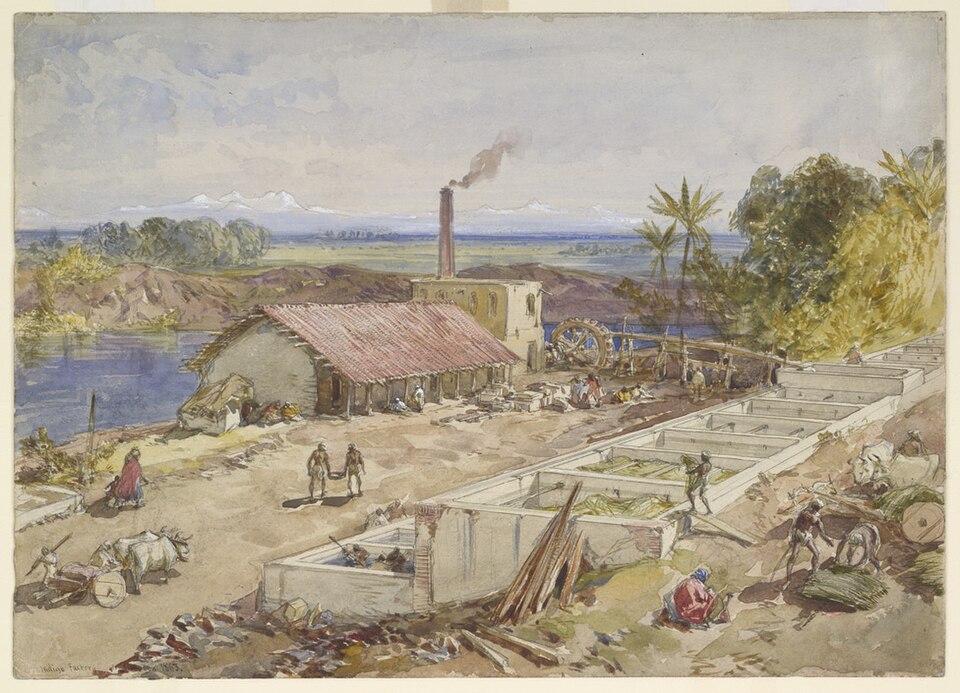
What did it achieve? The revolt forced the government to set up an official enquiry in 1860. It also broke the indigo plantation system in lower Bengal. The lesson that united, peaceful refusal could defeat powerful planters was not forgotten.
Malabar and Pabna: class conflict and the communal label
The Moplahs of Malabar. Between 1850 and 1900 Malabar saw a series of Moplah (Mappila) risings. The Moplah peasants were Muslims and their jenmi landlords Hindus, and the landlords were backed by the police, courts and revenue officials. Repression continued until 1880, and the landlords even burnt the bodies of rebels to demoralise the peasants, which only provoked them further.
From class to communal. In 1875 an anonymous petition of the Moplah peasants to the Madras Government led to an enquiry. Fighting revived in 1882-85, with attacks on landlords' houses and, at times, on temples, which gave an anti-Hindu turn to what was at heart a conflict between tenants and landlords. By 1896 the struggle had taken an aggressively communal orientation, a colouring the colonial state was quick to stress.
Pabna: a fight for occupancy rights. In Pabna in Bengal, peasants had paid rising rents without resistance between 1858 and 1873. The trouble came when zamindars tried to destroy their newly acquired occupancy rights, turning them into tenants-at-will through forced written agreements and illegal dues. In 1873 the peasants formed an agrarian league, which soon covered the whole district.
A legal, disciplined movement. The Pabna peasants did not defy colonial authority; they said they wanted to be the 'Queen's ryots', under the Crown rather than the zamindar. They gathered with conch shells and drums, showed solidarity through 'night shouts', and used the courts, so violence was rare. The movement spread to Dacca, Rajshahi, Bakarganj, Faridpur, Tripura and Bogra.
The communal card again. More than two-thirds of the activists, and about 70 per cent of Pabna's people, were Muslims, so landlords tried to paint the movement as communal. Yet two of its prominent leaders, Keshab Chandra Roy and Shambhunath Pal, were Hindus. Landlord-leaning papers such as Amrita Bazar Patrika opposed the league.
The Deccan riots of 1875: Kunbis against Vanis
How the ryotwari system bred debt. In the Deccan the ryotwari settlement dealt directly with cultivators, and revenue had to be paid in cash. A class of Vani moneylenders lent to the Kunbi cultivators at 25 to 50 per cent interest. Under the old collective system the moneylender was subject to the village's authority, but now he was not.
Courts on the lender's side. The new courts and laws favoured the moneylenders, so more and more land passed from Kunbis to Vanis, and even a Kunbi's immovable property could be sold to recover loans. Rising population, economic dislocation and an ill-judged attempt by the government to raise revenue made matters worse. The bond between the Kunbis and the Vanis, which had held village society together, broke.
The rising. In 1875 the Kunbis rose against the Vanis, not to kill them but to seize and destroy their bonds and title deeds, which they saw as instruments of oppression. Young leaders of the Poona Sarvajanik Sabha and declining landed families took up the peasants' cause. As in Malabar, a conflict between debtor and creditor took the form of a conflict between castes.
Forest peoples rise: the Koyas and Birsa Munda's ulgulan
The Koya rebellion, 1879-80. In the eastern Godavari tract of present-day Andhra Pradesh and parts of Malkangiri in Koraput, the Koyas rose under Tomma Dora. Their grievances were the loss of customary rights over forests and moneylenders who controlled their lives through loans and land transfers. Hailed as the 'King' of Malkangiri, Tomma Dora led the seizure of the police station at Motu, but he was soon shot dead by the police and the rising collapsed.
The long road to Birsa. The Munda movement in Chotanagpur in south Bihar grew between 1874 and 1901 and covered about 400 square miles. At first many Mundas accepted Christianity, hoping that German missionaries would check the zamindars' abuses. In 1867 as many as 14,000 'Christians' petitioned the authorities against the Raja of Chotanagpur and the local police, and some lands were restored.
From missions to rebellion. In March 1879 the Mundas claimed that Chotanagpur belonged to them, and in 1881 some sardars set up a kingdom at Doesa. Disappointed, they broke with the German missions, while officials and zamindars drew closer together. The struggle now united the rebels against all Europeans, including missionaries and officials, as well as the dikus (outsiders) and landed groups.
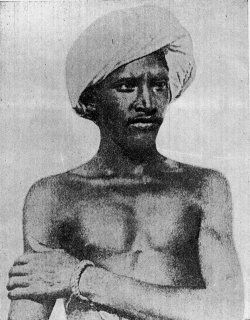
Birsa's ulgulan. From about 1895 the movement was led by Birsa Munda, who first became famous for his powers of healing. His followers imagined a just order free from both Indian and European exploiters, and women took an active part. Importantly, the movement showed no hostility towards poor non-tribal people, and it was ruthlessly suppressed.
The first industrial workers and their struggles
Where did the workers come from? A new working class formed out of peasants and artisans who had lost their old livelihoods. British capital built tea plantations from 1839 and then jute, coal, mining and the railways from the early 1850s, while ports took on many workers by 1900. The one modern industry dominated by Indians was cotton textiles, centred in Bombay and Ahmedabad.
Semi-servile conditions. Workers, including women and children, toiled 15 to 16 hours a day for low wages, and were sometimes beaten. Reports describe plantation workers dying of illness and eating worse food than jail prisoners. They were often recruited and led by jobbers (sirdars) from their own region and caste, who could sidetrack their demands.
Educated friends of labour. Some of the educated began to help. In 1870 the Brahmo Sasipada Banerjee founded a Working Men's Club, and in 1874 he started a journal from Baranagar near Calcutta. In Bombay N.M. Lokhande and S.S. Bengalee worked among mill hands from 1878.
The memorandum of 1884. Their efforts produced a memorandum signed by about 5,000 workers and placed before the Bombay Government's commission of 1884. It asked for a Sunday holiday, a half-hour break at noon, work from 6.30 a.m.
to sunset, wages by the 15th of the next month, and full wages for the injured with a pension for the maimed. It left its mark on the Indian Factories Act of 1891; an earlier Factory Act of 1881 had dealt mainly with child labour.
A weekly holiday, 1890. On 24 April 1890 Lokhande held a meeting of about 10,000 workers, at which two women workers spoke. A petition for a weekly holiday went to the Bombay Millowners' Association, which granted it on 10 June 1890. The workers saw it as a victory, but it had no legal force and could not be enforced.
Early strikes. Workers also struck on their own. River porters struck in Bengal in 1853 and coachmen in Calcutta in 1862, and in 1862 about 1,200 workers at Howrah railway station struck for an eight-hour day, some 24 years before the Chicago May Day movement. The Nagpur Empress Mills struck over wages in 1877, and there were 25 strikes in the Bombay and Madras presidencies between 1882 and 1890, many in Indian-owned mills.
Quick revision
- Local names: fituri, meli, hool, ulgulan; after 1857 landlords treated as 'natural leaders'.
- Orissa: Khonds of Ghumsar and Baud (1854-56), Chakra Bisoi, meriah ban; Savaras of Parlakhemedi (1856-57), Radhakrishna Dandasena hanged 1857.
- Santhals: interest 50-500%, bara ban / chota ban; 30 June 1855, Sido and Kanhu.
- 1857 debate: Stokes (elite-led) vs S.B. Chaudhuri, Rudrangshu Mukherjee (popular); 'Bania ka Raj'.
- Indigo revolt 1859-60: labour withdrawn; Nil Darpan (Dinabandhu Mitra, 1860); enquiry 1860.
- Moplahs (Malabar) vs jenmi landlords: petition 1875, revival 1882-85, communal by 1896.
- Pabna 1873-85: occupancy rights; agrarian league 1873; 'Queen's ryots'; leaders Keshab Chandra Roy, Shambhunath Pal.
- Deccan riots 1875: Kunbis vs Vani moneylenders (25-50%); bonds and deeds destroyed; ryotwari.
- Koya 1879-80: Tomma Dora, Malkangiri, Motu police station.
- Mundas 1874-1901; Birsa from c. 1895; 1867 petition of 14,000; Doesa 1881.
- Workers: Sasipada Banerjee 1870; Lokhande memorandum 1884 (~5,000) → Factories Act 1891; weekly holiday 10 June 1890.
- Strikes: Howrah 1862 (8-hour day, ~1,200); Empress Mills 1877; 25 strikes 1882-90.
UKPSC RO / ARO questions from this chapter
Tebhaga Movement was related to :
- (a) Tribes
- (b) Workers
- (c) Farmers
- (d) Untouchability
Show answer
(c) Farmers · our answer; official key awaited