

UPSC IFoS · Module 2 · standard depth · 25 min
The Later Vedic period
What UPSC IFoS asks from this chapter
Syllabus lines this chapter covers:
- Prelims Paper I: General Studies · History of India and Indian National Movement.
- Main: General Knowledge · The paper will also include questions on Indian Polity including the political system and the Constitution of India, History of India and Geography of a nature which the candidate should be able to answer without special study.
UPSC IFoS questions from this module are being sorted into our bank.
Cut to standard depth for UPSC IFoS. 9 deeper paragraphs are in the full chapter.
Start from zero: what changed after the Rig Veda?
In the Early Vedic chapter we met herders in Punjab who counted wealth in cows and chose their chiefs. Now move the clock forward to about 1000 BC and the map east to the Ganga-Yamuna Doab. The descendants of those tribes now live in villages, grow rice and barley, and their chiefs perform sacrifices that can last for years.
This phase, roughly 1000 to 600 BC, is called the Later Vedic period. It is the bridge between the tribes of the Rig Veda and the kingdoms of the Buddha's time. Almost every institution we associate with ancient India, like varna, gotra, the ashramas, the king's consecration and the Upanishads, takes its first clear shape here.
There is also a new material in the story: iron. Iron objects appear at most sites of this period. Older books said iron cleared the forests and made farming boom, but as we will see, the evidence tells a more careful story.
Why study this phase? Because it explains how inequality became an order. Priests, warriors, producers and servants were sorted into ranked groups, and rituals were used to justify the sorting. The questions this raises run straight into Buddhism, Jainism and the first states.
Early vs Later Vedic at a glance
| Theme | Early Vedic (c. 1500-1000 BC) | Later Vedic (c. 1000-600 BC) |
|---|---|---|
| Region | Sapta-Sindhava (Punjab, Haryana) | Ganga-Yamuna Doab, upper and middle Ganga |
| Texts | Rig Veda family books | Sama, Yajur, Atharva, Brahmanas, Aranyakas, Upanishads |
| Archaeology | Post-Harappan villages | Painted Grey Ware; iron |
| Economy | Mainly pastoral; barley | Mixed farming; rice and barley |
| Polity | Jana; chosen chief; Sabha and Samiti | Janapada, rashtra; consecrated king; Sabha stronger |
| Society | Kin-based; varna only in Purusha Sukta | Varna taking shape; gotra; three ashramas |
| Gods | Indra, Agni, Varuna | Prajapati, Rudra, Vishnu |
| Ritual | For the clan; simple | For one patron; long and complex |
Read the table as a direction, not a jump. None of these changes happened overnight. Many Early Vedic habits survived, and many Later Vedic ideas appear first in the late tenth mandala of the Rig Veda.
The sources: texts and pots
A library of new texts. The late parts of the Rig Veda, especially the tenth mandala, belong to this phase. So do the other three Vedas: the Samaveda, which sets Rig Vedic hymns to tune for singing at rituals, the Yajurveda, which lays out the rituals that go with the hymns, and the Atharvaveda, which records the folk beliefs of ordinary people.
Commentaries and philosophy. After the Samhitas come the Brahmanas, prose commentaries that explain why and how each ritual is done, full of myths and legends. Then come the Aranyakas and the Upanishads, which are mainly philosophical. Together these texts tell us far more about society than the hymns alone.
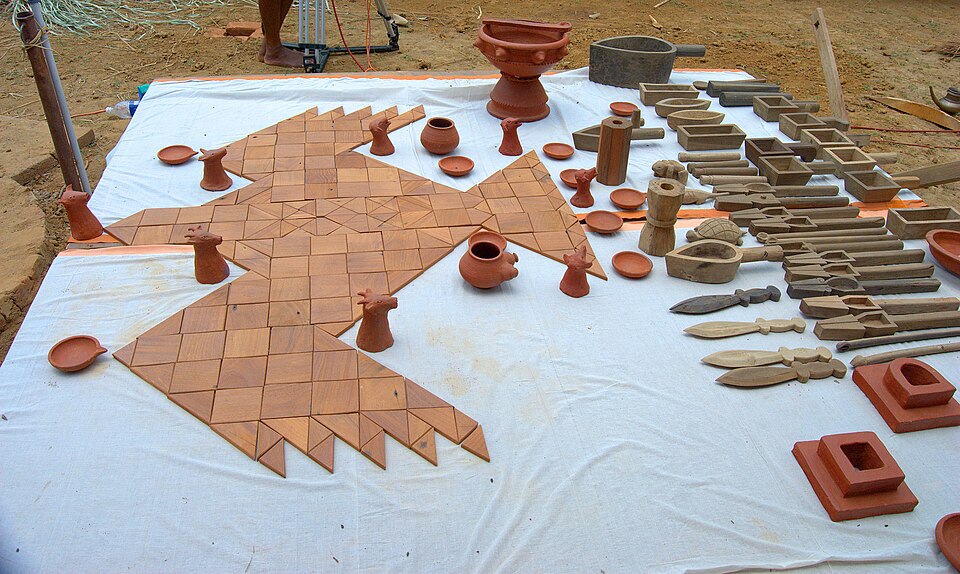
The Vedangas. A third layer, the Vedangas or 'limbs of the Veda', deals with phonetics, grammar, etymology and astrology. Its biggest part, the Kalpasutra, has four branches: Srauta Sutras on grand rituals like the asvamedha and rajasuya, Grhya Sutras on household rites, Dharma Sutras on social rules, and Sulba Sutras on the geometry of altars. These were composed over a long span, roughly 800 to 200 BC, so they reach well beyond our period.
What about the epics? The Mahabharata and Ramayana are set mostly in the upper and middle Ganga basin, and historians think their core may reflect this phase. But there is nothing to prove that the stories happened, and both epics took centuries to reach their present shape. So they are used carefully, as a mirror of many societies rather than a record of one.
The pottery evidence. In the same region and time, archaeologists find farming villages that used a fine pottery called Painted Grey Ware (PGW). More than 700 PGW sites are known, from the dry beds of the Ghaggar in Bahawalpur and northern Rajasthan to the Ganga-Yamuna Doab. Their eastern limit is marked by Sravasti.
Sites to remember. Important PGW sites include Atranjikhera, Ahichhatra, Noh, Hastinapur, Kurukshetra, Bhagwanpura and Jakhera. Some Black and Red Ware users of the Banas culture of southern Rajasthan may also have reached the Ganga valley by about 800 BC.
A gap between books and spades. The texts describe Vedic tribes moving eastwards, but archaeology does not show any single culture making that move. Many groups are named in the texts, so no pottery type can be pinned to one tribe. What both sources agree on is a society of settled farmers who used iron.
Iron: the myth and the evidence
When did iron arrive? Iron objects are found at most PGW sites. Carbon-14 dates from Atranjikhera, Jodhpura and Noh suggest that iron came into use in the Gangetic plains around 1000-800 BC. Iron ore was worked in Uttar Pradesh, Himachal and Punjab, and later in south Bihar.
What the texts call it. The Rig Veda mentions ayas, which may mean metal in general. Later texts are more precise: the Yajurveda speaks of syama ayas and the Brahmanas of krishna ayas, both meaning the 'black metal', iron. So texts and archaeology agree that iron belongs to the Later Vedic age.
Not an Aryan gift. Iron working here was an indigenous development. Excavations show that the megalithic people of south India also knew iron. So historians no longer say that migrating Aryans brought iron technology into the subcontinent.
The old theory. It was once argued that socketed iron axes cleared the thick forests of the Doab and that iron ploughshares and hoes made farming far more productive. On this view, iron was the engine that turned pastoral tribes into farming societies. It is a neat story, which is why it appears in many older books.
What the finds actually show. Most excavated iron objects are weapons: arrowheads and spearheads, with the largest number from Ahichhatra. Sickles, hoes and axes are rare, and only one ploughshare, from Jakhera, has been reported, probably from the end of the period. The rich iron ores of Bihar were not yet exploited, and smelting was still primitive.
How were forests cleared then? Mainly by burning. The Mahabharata story of burning the Khandava forest to found Indraprastha reflects this practice. Iron arrowheads and horse-drawn chariots made warriors more effective, and wars over land were common.
The verdict. In this period iron mattered most for war, not for daily farming. It began to transform agriculture only in the second half of the first millennium BC, when the marshlands and monsoon forests of the middle Ganga valley were gradually cleared. That later change, as we will see in the next chapters, helped feed the cities and kingdoms of the Buddha's age.
Economy: from herds to fields
Why farming grew. The vast, fertile alluvial plains of the Ganga-Yamuna Doab and the middle Ganga valley made farming attractive. These lands were settled slowly over the whole first millennium BC. Yet the texts still show that cattle and herding mattered.
Mixed farming. Pastoralism was no longer the main way of life as in the Early Vedic period. The norm was now mixed farming, combining cultivation and herding. Think of a village that grows grain in its fields and still grazes cattle on the edges.
Rice enters the plate. Both texts and archaeology show rice becoming a staple. PGW and Banas sites yield charred rice grains, and the texts use the words vrihi, tandula and sali for rice. Fields grew both barley and rice.
Signs of the plough. Later Vedic texts speak of eight, twelve and even twenty-four oxen yoked to a plough. The number is probably symbolic, but it shows that plough cultivation was familiar. Offerings in grand sacrifices like the rajasuya also included grain along with milk, ghee and animals.
Not yet wet rice. Rice remains come from raised ground in the Doab. This suggests that labour-heavy wet rice cultivation, with transplanting in flooded fields, was not yet practised. Farming was still fairly light on labour.
Houses that stayed. PGW deposits are often 2 to 3 m deep, meaning people lived at one spot for a long time. At Bhagwanpura and Jakhera, earlier circular huts of wattle and daub or wood gave way to sturdier houses with earth walls. Durable houses go with a settled life.
Who owned the land? Land was worked with family labour and the help of domestic servants and slaves. At first it belonged to the clan (vis), but ownership slowly passed to the family. This made the grihapati (householder) a man of wealth.
The vis becomes the vaishya. The vaishyas, those who came from the vis, became the producing class. They gave prestations (customary payments) to the kshatriyas for protecting their lands, and dana and dakshina (gifts and fees) to priests. In this way the producers fed the two groups who did not grow food.
Land was not a commodity yet. There are no references to the sale of land. In one story the earth herself rebukes King Visvakarma Bhauvana for trying to make a grant of land. This suggests that the vis still held strong shared rights over land.
Polity: from tribe to territory
From jana to janapada. In the Rig Veda, jana meant a people or tribe. Now the idea of janapada appears, meaning the area where a tribe settled, literally the place where the jana set foot. The word rashtra is also used for the first time, though not yet for a state with fixed borders.
Kurus and Panchalas. The Kurus, formed by the union of two major Vedic tribes, the Bharatas and the Purus, held the upper part of the Ganga-Yamuna Doab. The Panchalas occupied the middle Doab, called Panchala desa. When the two came together, their hold over the upper and middle Doab was complete, and tribal names were turning into place names.
Why it matters. This merging of tribe and territory is the first step towards the janapadas and mahajanapadas of the sixth century BC. A people that identifies with land will defend it, tax it and fight for more of it. That logic drives the next chapter of Indian history.
From rajanya to kshatriya. The rajanya, already a superior lineage in the Rig Veda, now became the kshatriya, literally 'those who hold power over dominions'. The chief was no longer just a cattle raider. He was the protector of the territory where his people settled.
Gifts turn into taxes. The vis had to give prestations to the kshatriya in return for protection, and its status slowly fell below his. Bali and bhaga, once offerings given at will, gradually became regular tributes and taxes. This is how an obligation became a duty.
Assemblies change. The Sabha became more important than the Samiti. References to rajas in the Sabha suggest it was a body of chiefs who helped the king. The village headman, the gramani, was drawn in as one of the king's supporters, which helped win over the vis.
Why kings needed big sacrifices. There was still no firm rule of heredity or succession by the eldest son. So rulers turned to grand consecration rituals, the rajasuya, asvamedha and vajapeya, performed on a lavish scale. In the rajasuya, for instance, the sacrificer was proclaimed king.
The horse sacrifice grows. In the Rig Vedic period the asvamedha was a small affair. Now it was used to assert control over other areas and legitimise the ruler's hold over them. Later dynasties, too, used such sacrifices to give religious legitimacy to new power.
Still not a sovereign. The raja was not yet an absolute monarch. He was chosen from among the kshatriyas, could be removed, and was answerable to the clan. He also did not appoint the other chiefs who helped him, as they were chiefs in their own right.
Wars for land. Conflicts were no longer just cattle raids; land was now a prize. A growing population needed more territory, and iron weapons and light horse chariots made fighting more effective. The Mahabharata's war between the Kauravas and Pandavas, both of the Kuru clan, is the famous image of such conflict.
The priest rises with the king. As the kshatriya rose, so did the brahmana, who performed the rituals that legitimised the king. The king, as yajamana, passed much of his wealth to priests as dana and dakshina. Wealth now flowed between the two top groups, not across the whole tribe.
Society: varna, gotra and the household
The famous hymn. The Purusha Sukta, from a late part of the Rig Veda, is the first text to describe four varnas. It says the brahmana came from the mouth of the primeval man, the kshatriya from his arms, the vaishya from his thighs and the shudra from his feet. The image presents society as one body, but with clearly unequal limbs.
Three things varna decided. In the Later Vedic texts, varna identities took shape around three concerns: access to ritual, access to political power and access to resources. These overlapped constantly. Remember also that our texts were written by brahmanas, so they show the brahmana's view, which others may not have accepted.
Who could be a priest? The answer that emerged combined birth with knowledge of the Vedic tradition. Birth was necessary but not enough on its own. In effect, men of other varnas, and all women, were shut out from acting as ritual specialists.
Brahmana and kshatriya. Many myths explore rivalry between priest and warrior, and in the texts the brahmana always wins. Yet they insist the ideal is cooperation, with the king accepting brahmana supremacy. Real relations probably varied from place to place.
Kshatriya and vis. The texts look back to a time when warrior and clan supported each other. In the Later Vedic picture the kshatriya takes resources from the vis, and the vis's resentment and threat to withdraw support appear real. Drawing leading men like the gramani into government was one way to keep the peace.
The shudra. Shudras appear only at the margins of Later Vedic texts. When present at rituals, special precautions were taken, and they were usually given roles that marked them as subordinate. In the later Dharma Sutras, their only assigned role is serving the three higher varnas.
Not a rigid system. Was varna fixed? The texts themselves admit that some shudras could be wealthy, and some held that the ruling Nanda dynasty was of shudra origin.
Buddhist and Jaina texts place the kshatriya first, before the brahmana. Untouchability was not yet a developed idea in this period.
Gotra. The institution of gotra, literally a 'cow pen', appeared in this period. It meant descent from a common ancestor. People practised gotra exogamy: marriage within the same gotra was not allowed.
One kind of household. The Rig Veda knew both the dam, run jointly by husband and wife, and the grha under one male head. In Later Vedic texts the grha with its grihapati became almost the only recognised form. The ideal grha had three parts: a wife of the same varna, cattle, and sons.
The grihapati's role. He produced wealth by his own effort, offered hospitality, and as yajamana paid for sacrifices that channelled part of his wealth to priests. The grihapati later appears in Buddhist texts as an ideal patron of the sangha. The whole picture is of a patriarchal order with the householder at its centre.
Ancestors and rivals. The pitrs, three generations of male ancestors (father, grandfather, great-grandfather), were now invoked at almost every ritual. Honouring the male line helped claim inheritance. Rival kinsmen called bhratrvya ('brother-like man') and sapatna ('rival') became a worry, and rituals were designed to defeat them and take their resources.
Women. A few women philosophers are known, and some queens took part in coronation rituals. But women were generally considered subordinate and kept out of major decisions. Some texts even began to describe daughters as a source of sorrow to their parents, a sharp fall from the Early Vedic picture.
Three stages of life. Three ashramas were prescribed: brahmacharya (student), grihastha (householder) and vanaprastha (partial retirement to the forest). The fourth, sanyasa or complete renunciation, was not known until the Upanishads. Later ascetics were often people protesting, quietly or openly, against the Vedic social order.
Religion: sacrifice, new gods and the Upanishads
Two traditions. The texts show two religious streams. The Vedic one, of grand sacrifice, is recorded in the Sama and Yajur Vedas and the Brahmanas. The folk one is recorded in the Atharvaveda, and the fact that it was counted as a Veda shows how other beliefs were being absorbed.
What sacrifice now did. In Early Vedic times rituals were for the whole tribe, and the chief shared out wealth. Now rituals became so complicated that some lasted years, and only the rich could afford them. Gifts went not to the tribe but to the brahmanas who performed the rites.
Why rituals grew complex. A wrong chant was believed to bring disaster, so the performer needed expert priests. The priest, in turn, was believed to raise the patron to almost superhuman status above the rest of the tribe. Ritual thus became a machine for proving the superiority of chiefs and brahmanas.
From the clan to one patron. Rig Vedic prayers sought cattle, victory and sons mostly for the group. Later rituals were built for a single sacrificer, the yajamana, who alone benefited. Being able to sponsor a sacrifice became a public proclamation of status.
Priestcraft becomes a science. Vidhis, or rules, were laid down for each sacrifice, and offerings differed according to the patron's needs. Every act was given mystical meaning. There were even separate sets of priests for different stages of one ritual.
The gods change jobs. Indra and Agni, the stars of the Rig Veda, lost importance. Prajapati, the creator, rose, and creation myths matter to settled farming groups. Rudra, minor in the Rig Veda, became important, Vishnu was seen as creator and protector of the universe, and Pushan, once the protector of cattle, became the god of the shudras.
What the change tells us. The rise and fall of gods mirrors the move from pastoral to settled farming life. The early gods stood for clear natural forces like rain and fire. Now the link between a god and a natural element became complex and hard to trace.
The folk religion of the Atharvaveda. This Veda is a mine of magic and charms. Its hymns cover curing disease, prayers for health, charms for home, children, cattle and fields, and charms for love, marriage, rivalry and jealousy. Spirits like pisachas and rakshasas were invoked for good fortune or harm.
Gods for daily needs. In this folk stream, Indra was asked to kill a house-robber or a worm in the body, and the Asvins to protect crops and kill rats. Savitri was asked to choose a site for a new home, Pushan to bring safe childbirth, and Surya to drive away demons. Religion here was close to the daily life of the common person.
The turn inward. Towards the end of the period there was a strong reaction against priestly domination and the waste of costly sacrifices. The Upanishads answered it by stressing knowledge of the atman, the self or soul, over ritual. Religion was raised from material goals to philosophy.
Why the Upanishads matter. They stressed that the soul is changeless and indestructible, perhaps reflecting a search for stability in a time of new monarchies and republics. Their inward turn also challenged the brahmana's role as ritual priest. These same questions, about ritual, rebirth and release, are what the Buddha and Mahavira would take up.
Quick revision
- Period c. 1000-600 BC; shift from Sapta-Sindhava to the Ganga-Yamuna Doab.
- Texts: late Rig Veda (10th mandala), Sama, Yajur, Atharva, Brahmanas, Aranyakas, Upanishads; epics' core may reflect this phase.
- Vedangas: Kalpasutra = Srauta, Grhya, Dharma, Sulba (altar geometry); c. 800-200 BC.
- PGW: 700+ sites; Ghaggar (Bahawalpur) to Doab; east limit Sravasti; Atranjikhera, Ahichhatra, Noh, Hastinapur, Kurukshetra, Bhagwanpura, Jakhera.
- Iron: C-14 (Atranjikhera, Jodhpura, Noh) 1000-800 BC; syama/krishna ayas; indigenous; also south Indian megaliths.
- Iron mostly weapons (Ahichhatra); one ploughshare (Jakhera); forests burnt (Khandava); farming change later.
- Mixed farming; rice = vrihi, tandula, sali; barley too; no wet rice; earth-walled houses (Bhagwanpura, Jakhera).
- Land: clan to family; grihapati; vaishyas pay prestations, dana, dakshina; no sale of land (Visvakarma Bhauvana).
- Jana to janapada; rashtra first used; Kuru (Bharata + Puru) upper Doab, Panchala middle Doab.
- Rajanya to kshatriya; bali and bhaga become taxes; Sabha > Samiti; gramani.
- Rajasuya, asvamedha, vajapeya for legitimacy; raja chosen, removable.
- Varna around ritual, power, resources; shudras marginal; not rigid (Nandas; kshatriya first in Buddhist and Jaina texts).
- Gotra ('cow pen') exogamy; grha and grihapati; pitr (3 generations); bhratrvya, sapatna; women subordinate.
- Three ashramas; sanyasa only with the Upanishads.
- Gods: Indra, Agni fall; Prajapati, Rudra, Vishnu rise; Pushan god of shudras.
- Atharvaveda = folk magic; priestcraft and vidhis; Upanishads = atman over ritual.