

UPSC IES / ISS · Module 43 · standard depth · 12 min
The climate summits: from Berlin to Belém, one COP at a time
What UPSC IES / ISS asks from this chapter
Syllabus lines this chapter covers:
- IES: General Economics III · Environmental Economics
UPSC IES / ISS questions from this module are being sorted into our bank.
Cut to standard depth for UPSC IES / ISS. 8 deeper paragraphs are in the full chapter.
Start from zero: a meeting that never ends
Think of a housing society that must fix a leaking roof shared by all flats. One meeting cannot solve it. The residents meet every year, agree on who pays how much, check what was done, argue about fairness, and raise their ambition as the leak gets worse.
The world's climate talks work the same way. The United Nations Framework Convention on Climate Change (UNFCCC) created a yearly meeting of all its members, called the Conference of the Parties (COP). It is the Convention's supreme decision-making body, and every important climate deal has been agreed at one of these meetings.
The Convention has 198 Parties: 197 states and the European Union. They are divided into Annex I Parties, which are the industrialised countries and economies in transition, and non-Annex I Parties, which are mostly developing countries. This split, based on the principle of common but differentiated responsibilities, shaped the whole history of the talks.
This chapter walks through the COPs that matter for exams, from the first one in Berlin to the most recent in Belém and Antalya. For each, it explains what was decided, why it mattered and what India's stake was.
Berlin and Kyoto: binding targets for the rich
The Convention of 1992 set a goal but no binding numbers. At COP1 in Berlin in 1995, the Parties agreed in the Berlin Mandate that new commitments were needed for the period after 2000. They began negotiating a protocol with real targets.
The result was the Kyoto Protocol, adopted at COP3 on 11 December 1997. It entered into force only on 16 February 2005, after enough countries ratified it. Its targets applied only to 37 industrialised countries and the European Union, listed in Annex B, which were to cut emissions by an average of 5% below 1990 levels in the first commitment period, 2008–2012.
Kyoto also created three market mechanisms to lower the cost of meeting targets:
- International Emissions Trading: countries with spare allowances could sell them to others.
- The Clean Development Mechanism (CDM): developed countries could earn credits by funding emission-cutting projects in developing countries.
- Joint Implementation (JI): credits from projects in another industrialised country.
Developing countries such as India could host CDM projects in areas like renewable energy and efficiency. A second period, 2013–2020, was added by the Doha Amendment of 2012, which entered into force on 31 December 2020.
Why Kyoto disappointed. Fast-growing emitters had no targets, some major developed countries stayed out or left, and the second period came into force only on its very last day. These weaknesses pushed the world towards a different model.
The long road to Paris: Bali to Warsaw
As Kyoto's first period approached its end, countries began looking for a wider deal. At COP13 in Bali in 2007, they adopted the Bali Road Map, including the Bali Action Plan, which launched talks on long-term cooperation by all countries.
COP15 in Copenhagen in 2009 was meant to seal the deal, but it fell short. The Copenhagen Accord, put together by a small group of leaders, was only "taken note of" by the COP, not formally adopted. Yet it contained a lasting promise: developed countries committed to a goal of mobilising USD 100 billion a year by 2020 for developing countries.
The following years rebuilt trust step by step:
- COP16, Cancun (2010) established the Green Climate Fund (GCF), now headquartered in Songdo, Republic of Korea, to channel climate finance.
- COP17, Durban (2011) created the Durban Platform, a working group that had to complete a new agreement applicable to all no later than 2015.
- COP19, Warsaw (2013) set up the Warsaw International Mechanism for Loss and Damage, and invited all countries to begin preparing their intended nationally determined contributions.
Why this phase matters. The idea that every country would put forward its own pledge, rather than having targets handed down, took shape in these years. That bottom-up design is what finally made Paris possible.
Paris 2015 and the rulebook
The Paris Agreement was adopted at COP21 on 12 December 2015 and entered into force on 4 November 2016. India ratified it on 2 October 2016, Gandhi Jayanti. Its temperature goals and India's targets are explained in the chapter on climate treaties and India's targets.
What makes Paris different is its machinery. Every Party must communicate a Nationally Determined Contribution (NDC) every five years, and each new NDC is expected to be more ambitious than the last. This is often called the ratchet.
Two tools keep the ratchet turning. A global stocktake checks the world's collective progress, first in 2023 and then every five years. An enhanced transparency framework requires countries to report their emissions and actions in a common format, so that promises can be checked.
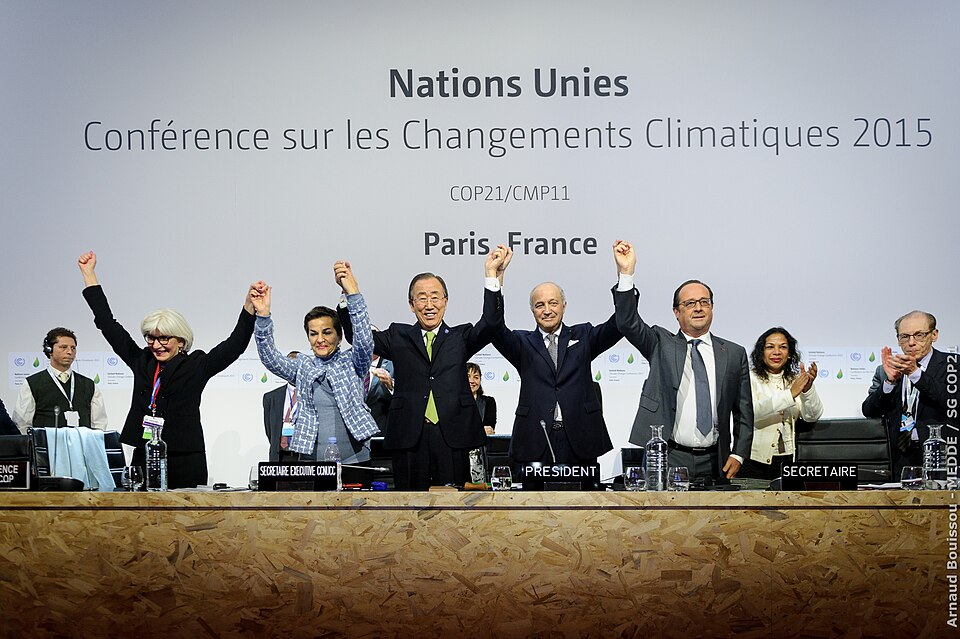
A treaty needs detailed rules to work. These were agreed at COP24 in Katowice, Poland, in 2018, in the Katowice climate package, popularly called the Paris rulebook. It set out how countries report, how the stocktake runs and how progress is reviewed.
Why this design? Kyoto showed that top-down targets drive countries away. Paris trades legally binding targets for a legally binding process: the content of each NDC is national, but the duty to submit, report and improve is shared. Critics say this relies too much on goodwill; supporters say it brought every country inside the tent.
Glasgow and Dubai: the fight over fossil fuels
For decades, climate decisions avoided naming the main cause of the problem: coal, oil and gas. That changed at COP26 in Glasgow in 2021. The Glasgow Climate Pact called for the "phasedown of unabated coal power and phase-out of inefficient fossil fuel subsidies".
The choice of "phasedown" rather than "phase-out" for coal was hard fought. Countries such as India argued that coal still powers much of their electricity, that poorer countries need time and support to switch, and that oil and gas, used heavily by rich countries, should not get softer treatment than coal.
COP28 in Dubai in 2023 concluded the first global stocktake of the Paris Agreement. Its outcome, often called the UAE Consensus, called on countries to contribute to "transitioning away from fossil fuels in energy systems", which the UN climate body described as signalling the beginning of the end of the fossil fuel era. It also called for tripling renewable energy capacity and doubling the rate of energy-efficiency improvements by 2030.
COP28 also operationalised the loss and damage fund on its opening day, as explained in the chapter on fighting climate change.
Baku, Belém and Antalya: money, forests and delivery
By 2024 the main question was money. COP29 in Baku, Azerbaijan set a new collective finance goal of at least USD 300 billion a year by 2035 for developing countries, replacing the old USD 100 billion goal, with a call to scale up to USD 1.3 trillion a year from all sources. Many developing countries said the amount fell far short of their needs.
COP30 met in Belém, Brazil, at the edge of the Amazon, in November 2025. Its main decision was named the "Global Mutirão", a Brazilian Portuguese word for a collective effort. It called for efforts to at least triple adaptation finance by 2035.
The Belém decision also launched a Global Implementation Accelerator and the Belém Mission to 1.5 to speed up action on existing pledges, and Parties agreed to develop a just transition mechanism to support workers and communities affected by the shift away from fossil fuels. The emphasis had moved from making new promises to delivering old ones.
Outside the negotiated text, Brazil's presidency launched the Tropical Forest Forever Facility, which aims to pay countries for keeping tropical forests standing. By the close of COP30 it had the support of 52 countries and the European Union, with commitments of nearly USD 6.7 billion.
COP31 is being held at Antalya, Türkiye, from 9 to 20 November 2026, under an unusual shared arrangement: Türkiye holds the presidency, while Australia's minister serves as President of Negotiations. Its outcomes will be added here once the conference closes.
Quick revision
- COP = supreme body of the UNFCCC, meets yearly; 198 Parties; Annex I vs non-Annex I.
- COP1 Berlin 1995: Berlin Mandate. Kyoto (COP3, 11 Dec 1997; in force 16 Feb 2005): 37 countries + EU (Annex B), −5% vs 1990 in 2008–12; IET, CDM, JI; Doha Amendment 2013–20, in force 31 Dec 2020.
- Bali 2007 road map; Copenhagen 2009: Accord "taken note of", USD 100 billion a year by 2020; Cancun 2010: Green Climate Fund (Songdo, Korea); Durban 2011: new deal by 2015; Warsaw 2013: loss and damage mechanism, INDCs.
- Paris (COP21, 12 Dec 2015; in force 4 Nov 2016; India ratified 2 Oct 2016): NDCs every 5 years, global stocktake 2023 then every 5 years, enhanced transparency; Katowice 2018 rulebook.
- Glasgow 2021: coal phasedown, phase-out of inefficient subsidies. Dubai 2023: first stocktake, transitioning away from fossil fuels, triple renewables, double efficiency by 2030.
- Baku 2024: USD 300 billion a year by 2035. Belém 2025: Global Mutirão, triple adaptation finance by 2035, just transition mechanism; TFFF (52 countries + EU, ~USD 6.7 billion).
- COP31: Antalya, Türkiye, 9–20 Nov 2026; Türkiye presidency, Australia leads negotiations.