

Module 1 · 14 min read · Free chapter
Tools of foreign policy: diplomacy, development partnership, soft power and economic diplomacy
India uses many tools to pursue its interests. Diplomats negotiate and summits set direction. India's development partnership gives lines of credit, grants and training under ITEC to neighbours and Africa. Soft power from yoga, films, culture, the diaspora and digital public infrastructure like UPI builds goodwill, while economic diplomacy seeks trade, investment and energy.
Start from zero: making friends in a new colony
Suppose your family moves into a new colony. You want good neighbours, help in a crisis and maybe customers for your shop. How do you get them?
First, you talk: you greet people, visit them and settle small quarrels by conversation. Second, you help: you lend a ladder or teach a neighbour's child maths. Third, you share who you are: you send festival sweets and invite people to your function. Fourth, you trade: you open a shop, buy from others and do business that helps both sides.
Countries use the same four tools. Talking is diplomacy, helping is development partnership, sharing culture is soft power, and trade and investment are economic diplomacy. Behind all four stands the quiet fifth tool, strength, which makes others take a country seriously.
This chapter explains each tool, when India started using it, why, and what it has achieved. At the end, it asks the Mains question: how well do these tools serve India's interests?
Diplomacy: the art of talking for a country
Diplomacy is the peaceful conduct of relations between states through talks, agreements and representation. It is the oldest and cheapest tool, and every other tool works through it.
India's diplomacy is run by the Ministry of External Affairs (MEA), which is tasked with framing the country's foreign policy and diplomatic relations. It works through more than 200 diplomatic missions abroad, such as embassies, high commissions and consulates. India's mission in a Commonwealth country is called a High Commission, and elsewhere it is an Embassy.
A mission abroad does five main jobs. It negotiates with the host government and reports home. It promotes trade and investment.
It serves Indians abroad with passports, visas and help in emergencies. It spreads Indian culture. It also reads the host country carefully, so that Delhi can make good decisions.
Diplomacy works at several levels. Bilateral diplomacy deals with one country at a time, while multilateral diplomacy works in large bodies such as the UN. Summit diplomacy brings leaders face to face, and Track II dialogues let retired officials and scholars test ideas that governments cannot yet say in public.
Why it matters: diplomacy prevents small problems from becoming wars. Even in the worst crises with neighbours, channels of talk are kept open, because a closed door costs more than an uncomfortable conversation.
Development partnership: why a developing country gives help
It may seem strange that India, which still has poor people of its own, helps other countries. The answer lies in both values and interest. India knows the problems of poverty first-hand, and helping others builds trust, markets and friends who vote with India in world bodies.
When and why it began. The Indian Technical and Economic Cooperation (ITEC) programme was instituted on 15 September 1964 by a decision of the Indian Cabinet. The Cabinet noted that a programme of technical and economic cooperation was essential for developing India's relations with other developing countries. India had just gone through the 1962 war and needed friends beyond the great powers, so sharing its own skills was a natural step.
What ITEC does. ITEC trains officials and professionals from partner countries in Indian institutes, in subjects such as administration, IT, agriculture, health and defence. It is essentially a bilateral programme, built on the request of the partner country. It now covers around 160 partner countries, and since 1964 it has trained close to 400,000 government officials from the Global South.
Why training matters so much. A trained official goes home with skills and with personal memories of India. Years later, that official may be a minister or a senior diplomat who understands India well. So training is a long-term investment in goodwill, and it costs far less than large loans.
Loans and grants: building things in partner countries
Training builds people, but partner countries also need roads, power lines, hospitals and railways. India helps build them in two ways: cheap loans and outright grants.
Lines of Credit (LOCs). A Line of Credit is a concessional loan, that is, a loan at a low interest rate and with a long repayment period. India extends LOCs under the Indian Development and Economic Assistance Scheme (IDEAS). It has extended more than 260 LOCs worth over US$ 26 billion to nearly 62 countries.
Grants. For close neighbours, India also funds projects that need not be repaid. Grant-in-aid projects worth around US$ 4.17 billion run in countries such as Afghanistan, Bangladesh, Bhutan, Myanmar, the Maldives, Nepal, Sri Lanka, Mauritius and Seychelles.
| Instrument | What it is | Scale |
|---|---|---|
| ITEC training | Courses for officials and professionals in Indian institutes. | About 160 partner countries and close to 400,000 officials trained since 1964. |
| Lines of Credit under IDEAS | Cheap loans for projects chosen by the partner. | More than 260 LOCs worth over US$ 26 billion to nearly 62 countries. |
| Grant-in-aid | Projects funded without repayment, mostly in the neighbourhood. | Around US$ 4.17 billion. |
Where the money goes. The neighbourhood gets the largest share. India has extended LOCs worth US$ 7.86 billion to Bangladesh, more than US$ 2 billion to Sri Lanka and US$ 1.43 billion to the Maldives. In October 2018, India also launched the India for Humanity initiative to mark Mahatma Gandhi's 150th birth anniversary.
Why India's model looks different. India stresses that its help is demand-driven: the partner chooses the project, and India does not attach political conditions. This is meant to contrast with loans that leave poor countries with debts they cannot repay. The criticism is that Indian projects are often slow to finish, which can hurt India's image when rivals deliver faster.
Soft power: winning hearts, not just arguments
Soft power is the ability to attract others through culture, values and example, so that they want what you want. India has a rich store of it: yoga, music, cinema, food, festivals, spiritual traditions, a working democracy and a large diaspora.
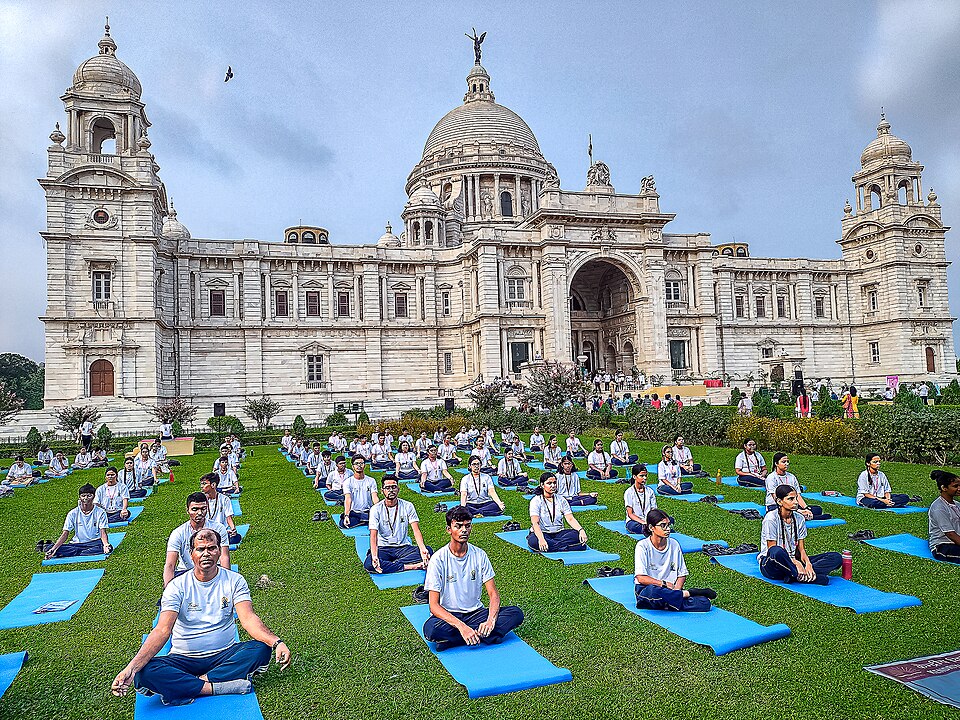
Yoga Day: a soft-power milestone. India presented a draft in the UN General Assembly on 11 December 2014 to mark 21 June as the International Day of Yoga. The resolution was passed unanimously and was co-sponsored by 175 nations. Every year since, people in cities across the world practise yoga on that day, and each session carries an Indian idea to new audiences.
Help in a crisis. Soft power also grows when a country stands by others in hard times. During COVID-19, India provided nearly 300 million vaccine doses to less developed and vulnerable countries. For many small states, India's vaccines arrived when richer countries were keeping doses for themselves.
Institutions for culture. India set up the Indian Council for Cultural Relations (ICCR) in 1950 to build cultural ties and mutual understanding with other countries. It runs cultural centres abroad, scholarships and visits by artists, much as France and China promote their languages through their own institutes. Cultural links can also keep doors open in bad times, as when Sikh pilgrims from India visit shrines in Pakistan even while political ties are strained.
The limits of soft power. Attraction does not automatically turn into support. A country may love Indian films and still vote against India in the UN. Soft power works best when it is backed by delivery, that is, projects finished on time and promises kept.
Why it matters: soft power is cheap and lasting, and it reaches people, not just governments. That is why Indian diplomacy now treats culture, health and digital public goods as serious tools rather than ceremony.
Economic diplomacy: trade, investment and energy
After 1991, as India opened its economy, foreign policy took on a new job: helping India grow. Economic diplomacy means using diplomacy to win markets for Indian goods and services, attract investment and technology, and secure energy and raw materials.
Trade agreements. A free trade agreement (FTA) cuts tariffs between partners. India's largest regional deal links it with the ten ASEAN countries. The ASEAN-India Free Trade Area was completed when the agreements on trade in services and investments entered into force on 1 July 2015.
Why FTAs are debated. An FTA opens markets for exporters, but it also lets cheaper imports in. Indian industry has often argued that some FTAs widened the trade deficit without matching gains. So India now negotiates more carefully, trying to protect sensitive sectors such as farming and dairy while seeking access for services and skilled workers.
Energy and resources. India imports most of its crude oil, so a large part of its diplomacy with the Gulf and others is about steady energy supply at fair prices. In the same way, India now courts partners that hold critical minerals needed for batteries, solar panels and electronics.
Why it matters: in today's world, power grows from factories, data and supply chains as much as from armies. That is why commercial goals now sit beside security goals in almost every high-level visit.
When, where and why: how India's toolbox grew
The first phase: principles as tools. In its early years India had little money or military power, so it relied on ideas and moral standing. The five principles of Panchsheel and the leadership of newly free nations gave India a voice far louder than its wealth.
The second phase: sharing skills. In 1964 India created ITEC to train officials from other developing countries. A poor country could not give large loans, but it could share the know-how it was building in its own institutes.
The third phase: money and markets. After 1991, faster growth let India offer larger Lines of Credit and sign trade deals, so economic diplomacy grew. The neighbourhood became the main focus of India's credit and grants.
The fourth phase: a voice for the Global South. Recent years added new tools. India won the Yoga Day resolution in 2014, shared vaccines during COVID-19, and hosted three Voice of Global South Summits in January and November 2023 and August 2024. In March 2025 the Prime Minister launched the MAHASAGAR doctrine in Mauritius, which frames India's maritime and development outreach in the Indian Ocean and beyond.
The implication. Each phase added a tool without dropping the old ones. India still talks the language of principles, but it now backs that language with training, credit, trade and security help, which makes its offer more complete.
Mains lens: are India's tools working?
1. The strengths. India's development help is demand-driven and free of political conditions, which partners value. Training through ITEC has built a wide circle of officials who know India well. Vaccine sharing and disaster help have shown India as a first responder in its region.
2. The weaknesses. Projects funded by Indian credit are often slow, which lets rivals with deeper pockets look more effective. India's diplomatic service is small for a country of its size, so missions are often stretched thin. Soft power, however attractive, does not always translate into votes or contracts.
3. The competition. Other powers now offer large loans and fast infrastructure in India's neighbourhood. India cannot match every offer in money, so it competes through trust, quality, local needs and its long cultural ties.
4. The way forward. India can speed up project delivery, expand its diplomatic cadre, partner with like-minded countries on joint projects, and offer its digital public infrastructure as a global good. A balanced conclusion is that India's toolbox is broad and well-meant, and its next task is delivery at scale.
Mains practice: five questions, five angles
These are practice questions written by us, not past papers. Past questions from each exam are in the PYQ panel of this module.
| Angle | Question | Key points to cover |
|---|---|---|
| Origin | Why did India start a development partnership programme in 1964, and how has it evolved? | Explain the Cabinet's 1964 reasoning on ties with developing countries and the setting after 1962. Then trace the growth from training to credit lines, grants and the Global South agenda. |
| Compare | Compare India's development partnership model with loan-heavy models in South Asia. | Show that India's model is demand-driven, mixes grants and soft loans and avoids political conditions. Then admit the problem of slow delivery and suggest fixes. |
| Soft power | "Soft power is India's most underused asset." Discuss. | Use the Yoga Day resolution with 175 co-sponsors and vaccine sharing as examples of success. Then explain why attraction needs delivery and how culture, diaspora and digital goods can be used better. |
| Economy | How has economic diplomacy changed India's foreign policy since 1991? | Explain the shift to trade, investment and energy goals and cite the ASEAN-India agreements of 2015. Then discuss the FTA debate and the new focus on critical minerals and supply chains. |
| Current | What does India's Global South outreach aim to achieve? | Cite the three Voice of Global South Summits of 2023 and 2024 and the MAHASAGAR doctrine of 2025. Then link them to India's search for votes, markets and a fairer world order. |
How to use this table: each answer should name the tool, explain why India uses it with one fact, and end with a practical way forward.
Quick revision
- The four main tools of foreign policy are diplomacy, development partnership, soft power and economic diplomacy, and strength stands behind all of them.
- The Ministry of External Affairs frames foreign policy and works through more than 200 missions abroad.
- ITEC was instituted on 15 September 1964 by a Cabinet decision, and it now covers around 160 partner countries.
- ITEC has trained close to 400,000 government officials from the Global South since 1964.
- India extends concessional Lines of Credit under IDEAS, with more than 260 LOCs worth over US$ 26 billion to nearly 62 countries.
- Bangladesh has received LOCs worth US$ 7.86 billion, the largest share in the neighbourhood.
- The UN proclaimed 21 June as the International Day of Yoga on India's draft of 11 December 2014, which had 175 co-sponsors.
- India provided nearly 300 million vaccine doses to less developed and vulnerable countries during COVID-19.
- The ASEAN-India Free Trade Area was completed on 1 July 2015, when the services and investment agreements came into force.
- India hosted three Voice of Global South Summits in 2023 and 2024, and it launched the MAHASAGAR doctrine in Mauritius in March 2025.